Tabla de contenidos
- What sustainable fleet management means for a passenger operation
- Load factor is the biggest emissions lever you have
- Idling: the fuel you burn standing still
- Driving style: the reduction that costs nothing
- Maintenance is an emissions program
- Route and schedule design
- Where electrification actually fits today
- How to measure and report it
Which puts a coach operator in an unusual position. Most companies approaching sustainable fleet management start from a deficit and try to climb out of it. A bus fleet starts as the cleanest passenger mode on the road and has to work out how to prove it, defend it, and stop giving the advantage away.
What sustainable fleet management means for a passenger operation
Sustainable fleet management is the practice of running a fleet so that emissions per unit of output fall over time, without degrading service. For a bus operator the unit of output is the passenger-mile, not the vehicle-mile, and that distinction decides everything that follows. A coach that burns 8% less fuel while running half empty has not improved its footprint in any way that matters.
This is where most green fleet management advice breaks down when applied to passenger transport. The generic playbook was written for delivery vans and light trucks, where the vehicle-mile is the right denominator and electrification is the obvious answer. Neither assumption transfers cleanly to an intercity coach running 600 kilometers a day.
Load factor is the biggest emissions lever you have
An empty seat carries the full environmental cost of the trip and returns nothing. The engine burns the same diesel over the same route whether 20 passengers are aboard or 45. Every point of load factor you add divides the same emissions across more people and pushes grams per passenger-mile down, with no capital expenditure whatsoever.
Run the arithmetic on a 45-seat coach: at 60% occupancy the trip emits roughly 50% more CO2 per passenger than the same trip at 90%. No engine upgrade available today delivers a reduction of that size. Schedule design, pricing and demand forecasting do, and they raise revenue at the same time.
That is the argument worth internalizing before spending on anything else. In a passenger operation, the same metrics that drive profitability drive the carbon footprint, because both are divided by the same denominator. Sustainability and yield management are the same project wearing different labels.
Deadhead miles are the mirror image. Repositioning runs, garage moves and empty return legs emit at full rate with a load factor of zero. Cutting deadhead from 12% to 8% of total mileage removes those emissions entirely rather than reducing them.
Idling: the fuel you burn standing still
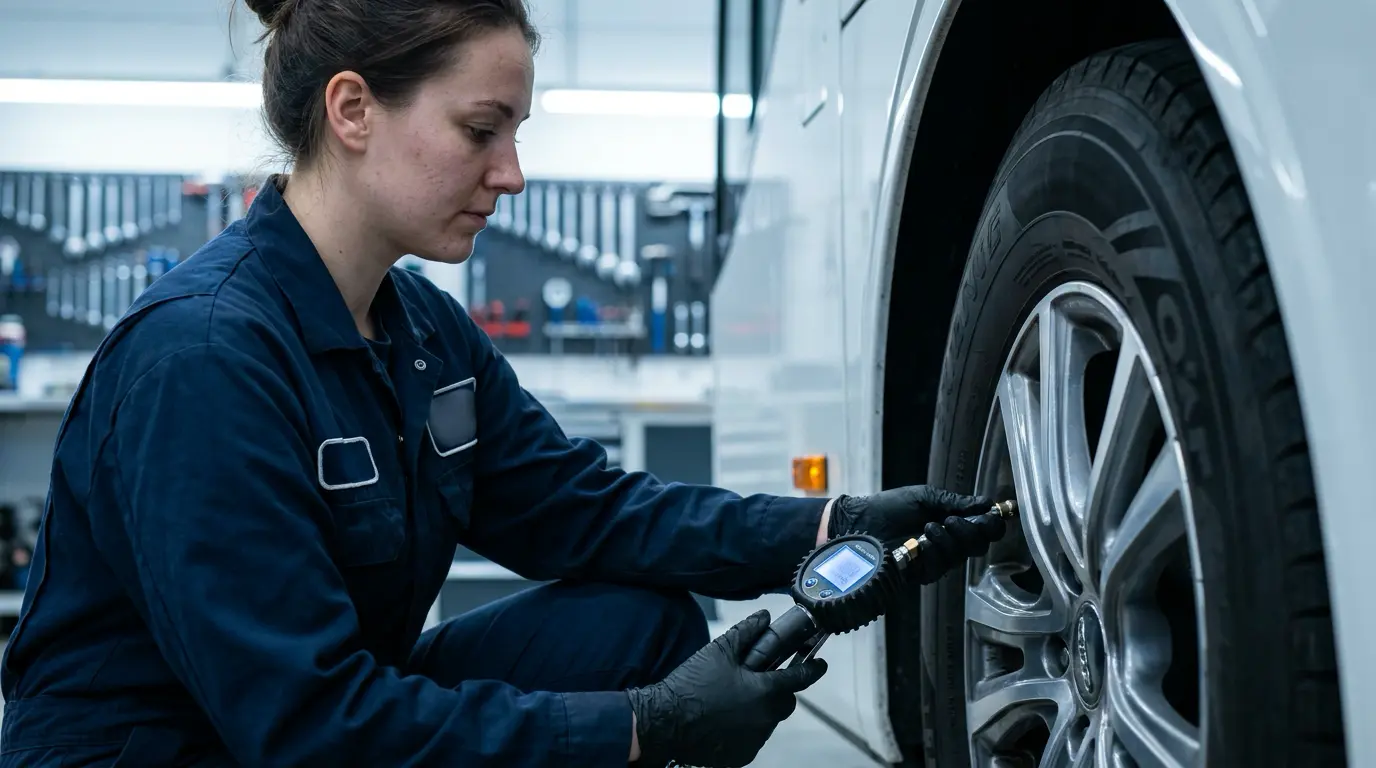
Terminal idling is the most preventable waste in the operation. A coach idling to keep the cabin conditioned while passengers board burns fuel at a rate that produces zero passenger-miles, which means its contribution to emissions per passenger-mile is mathematically infinite.
The equipment side has improved considerably. Modern coaches with Clean Idle certified engines cut idle nitrogen oxide emissions to roughly half the regulatory limit of 30 grams per hour. But certification does not reduce the diesel burned. Only policy and measurement do:
- Set a maximum idle time per stop and track it per unit through telematics, not by memory.
- Separate justified idling from habit. Pre-conditioning the cabin in 35°C heat before boarding is service. Twenty-five minutes idling in a depot is not.
- Report idle percentage per driver monthly. Visibility alone typically moves the number before any training happens.
Driving style: the reduction that costs nothing
Harsh acceleration, late braking and sustained speeds above the efficiency band of the engine can swing real-world consumption by 10% to 15% between two drivers operating identical coaches on the same route. That gap is not a mystery once you measure it, and it is the cheapest fleet emissions reduction available to any operator.
The mechanism is coaching, not punishment. Driver behavior monitoring produces the score; a monthly conversation about the two or three events that moved it produces the change. Programs that publish a leaderboard without explaining what it measures tend to generate resentment and gaming rather than fuel savings.
Speed management deserves separate attention on long-haul routes. Diesel consumption rises sharply above roughly 90 km/h, and on an overnight run the difference between a disciplined cruise speed and an aggressive one shows up as several percentage points of annual fuel spend.
Maintenance is an emissions program
A poorly maintained coach is a dirtier coach, and the causes are unglamorous: clogged air filters, underinflated tires, injectors past their service interval, worn exhaust after-treatment. Each one raises consumption by a few percent, and they compound quietly because none of them triggers a breakdown.
Tire pressure alone is worth a standing checklist item. Underinflation increases rolling resistance and fuel burn while cutting tire life, so the same neglect shows up twice in the cost sheet and once in the emissions figure.
Running services on schedule rather than on failure is what keeps consumption near the specification the manufacturer published. The logic behind predictive maintenance applies here even without sensors: a fleet with preventive maintenance compliance above 95% burns measurably less fuel than the same fleet at 70%, because the degradation never accumulates.
Route and schedule design
Kilometers not driven are the only emissions you never have to offset. Route optimization in a scheduled passenger operation is less about rerouting mid-trip, as it would be in delivery, and more about the structural decisions: which stops earn their detour, whether two thin departures should be consolidated into one full one, how vehicles are assigned so the largest coaches run the fullest legs.
Consolidating departures is the uncomfortable one, because it trades frequency for occupancy. Two coaches at 45% carry the same passengers as one at 90%, at nearly double the fuel and double the emissions. Whether that trade is acceptable depends on the corridor and on what your passengers are actually buying, but it should be a deliberate decision rather than an inherited timetable nobody has revisited.
Where electrification actually fits today
Most eco-friendly fleet content treats electrification as the destination and everything else as an interim step. For intercity coach operations in Latin America that sequence is inverted, for reasons that are practical rather than ideological:
- Range against route length. Battery-electric coaches are viable on fixed urban and suburban duty cycles. A 700-kilometer overnight run through mountain terrain is a different engineering problem.
- Charging infrastructure. Depot charging requires grid capacity that many terminals do not have, and intermediate charging on intercity corridors is largely nonexistent.
- Capital structure. With 87% of coach companies operating fewer than 25 vehicles, fleet replacement is a decade-long process funded from operating margin, not a procurement cycle.
The reasonable posture is to plan replacement rather than to wait for it. When units come up for renewal, the current-generation diesel coach is substantially cleaner than the one it replaces, and specifying it correctly captures most of the available gain now. Pilot electric or hybrid units on the shortest, most predictable routes in the network, where the duty cycle actually fits, and let that data inform the next purchase.
How to measure and report it
A sustainability program that cannot produce a number is a communications exercise. Four metrics are enough to run one honestly:
- Liters per 100 kilometers per unit and per route, not as a fleet average.
- Grams of CO2 per passenger-mile, calculated from fuel consumed and passengers carried. This is the headline figure and the only one that captures load factor.
- Idle percentage of total engine hours.
- Deadhead percentage of total mileage.
Establish a baseline before changing anything, then measure quarterly. Without a baseline, every subsequent claim is unverifiable, and corporate clients running their own emissions reporting will ask for the methodology, not the adjective.
That last point is turning into commercial pressure rather than reputation management. Companies that contract staff transport increasingly need supplier emissions data to close their own reporting, and the operator who can produce a documented figure per passenger-mile wins tenders against operators who can only describe themselves as green.
The obstacle is almost never willingness. It is that fuel lives in one system, mileage in another, and passenger counts in a third, so the calculation takes a week and nobody repeats it. Operations that centralize ticketing, fleet and fuel data in a single transport management system can produce the figure on demand. See how the platform works.