Tabla de contenidos
- What Are Employee Transportation Benefits?
- Why Companies Are Investing in Employee Mobility Right Now
- The Main Types of Employee Transportation Benefits
- How Employee Transportation Programs Impact Retention and Recruitment
- The ROI Math: What Companies Actually Save
- In-House Fleet vs Partnering With a Transportation Operator
- The Technology Layer: How Modern Programs Actually Run
- KPIs to Measure Program Success
- Frequently Asked Questions
- From Line Item to Strategic Lever
This guide is written for the company leader evaluating whether to launch or expand a program, not for the shuttle vendor selling one. It covers what these benefits actually are, why the business case has sharpened, the main program types, the ROI math, the in-house-versus-partner decision, the technology layer that makes modern programs run, and the KPIs that prove the program is working.
What Are Employee Transportation Benefits?
Employee transportation benefits are programs that help workers get to and from work, provided or subsidized by the employer. They range from pre-tax commuter deductions and transit pass subsidies to company shuttles, vanpools, ride-share stipends, and parking support. Some are tax-advantaged under local law, others are direct mobility services. Most mature programs combine both.
The term actually covers two layers that often get confused in search results. The first is the tax-advantaged benefit, where the employer helps the employee pay for transit, parking, or vanpooling on a pre-tax basis. In the US, IRS Section 132(f) allows up to $340 per month (2026 limit) in qualified transportation expenses, excluded from gross income. The second layer is the actual mobility service: a company shuttle running from a residential zone to the office, a vanpool between campuses, a late-shift pickup for third-shift workers.
A company can offer one without the other, but the best programs integrate both: the tax perk reduces cost for everyone, and the service makes the commute physically possible for the workers who need it most.
Why Companies Are Investing in Employee Mobility Right Now
Three pressures are converging. Voluntary turnover in the US averaged 13% in 2025, according to Mercer’s Workforce Turnover Survey. That’s down from 17.3% in 2023 but still represents a significant cost center. Gallup’s Employee Retention and Attraction Indicator shows 51% of US employees are actively searching for or watching for a new role. The pool of workers ready to leave has not contracted as much as the headlines suggest.
Return-to-office mandates are the second pressure. Workers who got used to saving two hours of daily commute during remote-work arrangements are now weighing that time back against salary, and many are finding the math unfavorable. Companies bringing people back on-site have an urgent interest in reducing commute friction to protect the investment they made in hiring during the remote era.
The third pressure is ESG. Investors, enterprise clients, and regulators are asking for Scope 3 emissions reporting, and employee commuting is a major component of that footprint. According to the United Nations, shifting from individual cars to public or shared transportation can reduce up to 2.2 tons of CO2 per person per year. A structured program doesn’t just improve retention; it moves a sustainability metric that increasingly appears in RFPs and investor disclosures.
Add recruitment pressure on top. In competitive labor markets, the benefits package is a signal. Offering reliable mobility tells a candidate the company has thought about their daily life, not just their compensation.
The Main Types of Employee Transportation Benefits
A full program usually blends several of the following components, selected based on workforce location, budget, and local regulation:
- Pre-tax commuter benefits. Payroll deductions for transit passes, parking, or vanpools that reduce taxable income for the employee and payroll tax for the employer. Covered under IRS Section 132(f) in the US, with parallel frameworks in other markets.
- Transit pass subsidies. Direct employer contribution toward a monthly or annual public transit pass. Simple to administer and most effective in metros with mature public transit networks.
- Vanpools and carpools. Employer-organized or employer-subsidized shared rides between home clusters and the worksite, typically serving six to fifteen riders per vehicle. Usually qualifies for tax benefits.
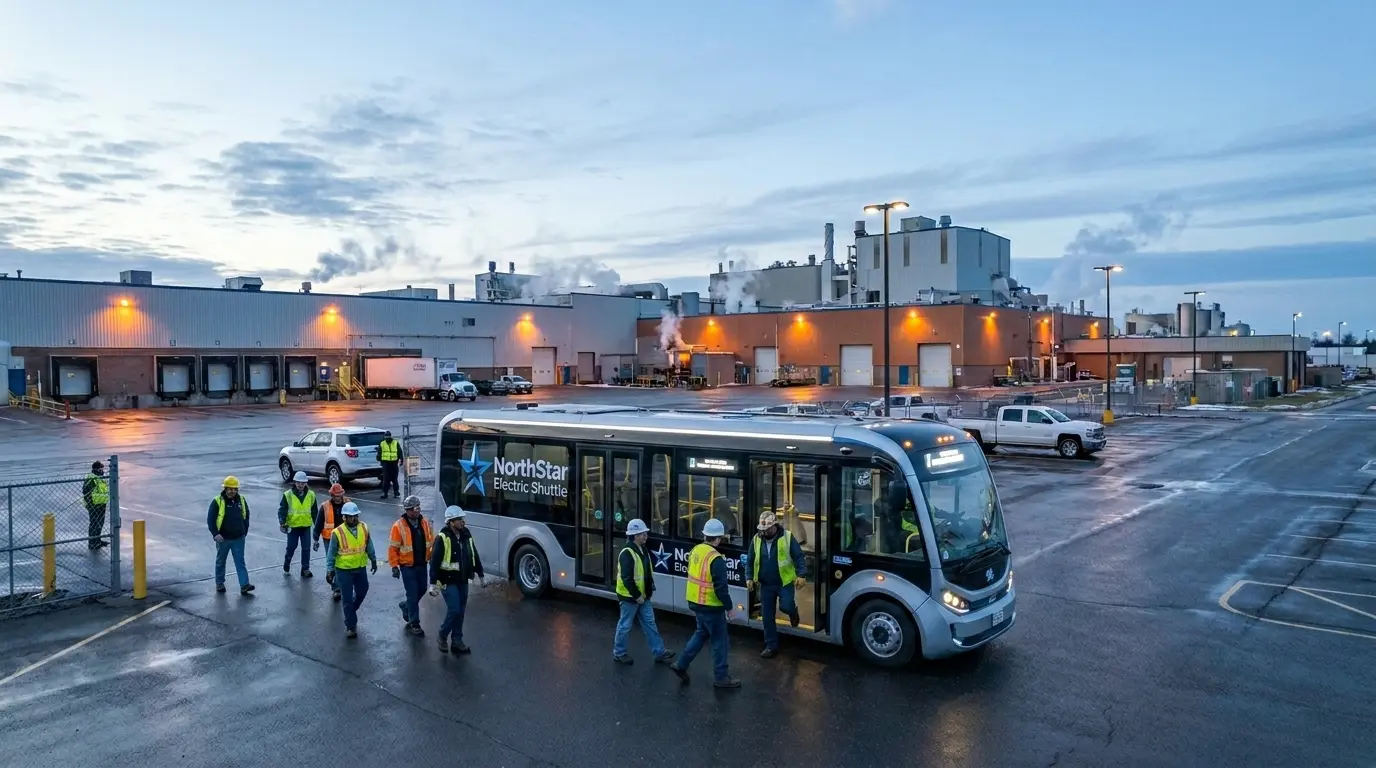
- Company-operated shuttles. Fixed-route or on-demand buses, run in-house with a company fleet or through an employee shuttle service partner. Most common for large campuses, industrial sites, or locations with weak public transit coverage.
- Ride-share stipends. Monthly credit for rideshare services, useful for late-shift workers, small teams, or irregular schedules where a full shuttle isn’t justified.
- Parking benefits. Direct subsidy for workplace parking, typically paired with other options so employees who can take transit don’t lose the equivalent value.
The design question isn’t which component is best in isolation. It’s which combination matches the workforce’s actual commute patterns.
How Employee Transportation Programs Impact Retention and Recruitment
The link between commute and retention is not theoretical. A 2018 Robert Half survey of 2,800 workers across 28 US metros found 23% had quit a job they otherwise would have kept because the commute became unsustainable. Among workers aged 18 to 34, the figure jumped to 34%. That demographic is now the majority of the US labor force.
The recruitment side shows the same pattern from a different angle. Zeelo, a managed shuttle operator, reported that a supermarket distribution-center client saved over $480,000 in hiring spend after launching a managed shuttle program. A separate Zeelo case with a temp-staffing client showed job-fill rates moving from 62% to 104% of target within the first month after shuttle launch.
For site managers and HR leaders, these outcomes translate directly: fewer no-shows, shorter time-to-fill for open roles, lower onboarding investment lost to early attrition. The program stops being a perk and starts being a workforce-availability tool.
The ROI Math: What Companies Actually Save
Full turnover cost is routinely underestimated. Culture Amp puts total replacement cost between 30% and 200% of an employee’s annual salary, depending on role complexity. For a position earning $60,000 a year, that’s between $18,000 and $120,000 per departure in direct and indirect cost. SHRM estimates the average hiring cost at $4,129 with 42 days to fill a vacancy, and that’s before counting productivity loss, lost institutional knowledge, and team-morale impact.
Against those numbers, a commuter benefits program pays for itself quickly. In the US, once two employees participate in a pre-tax plan, employer payroll tax savings (up to 7.65% per participant) typically cover the administrative fee. Layer in a retention impact of just one avoided resignation per 100 employees per year, and the ROI flips strongly positive.
The harder number to quantify but easier to feel is absenteeism. Employees who can’t reach work reliably show up late, call out, or leave early. Every one of those events has a cost; a structured transportation benefit removes the cause.
In-House Fleet vs Partnering With a Transportation Operator
Once a company decides to offer mobility as a benefit, the next decision is who runs it. Three models dominate:
- Pure in-house. The company buys or leases vehicles, hires drivers, and operates the service internally. Makes sense when the operation is large, predictable, and tightly tied to the core business — manufacturing plants, mining operations, healthcare systems with their own facilities, or corporate campuses with steady shift patterns. Requires transportation expertise most companies don’t have.
- Fully managed partner. An employee shuttle service provider designs routes, supplies vehicles and drivers, handles compliance, and delivers monthly reports. The company pays a service fee per route or per mile. Faster to launch, scales up and down easily, lower internal overhead. Most companies starting out choose this route.
- Hybrid. The company owns vehicles but contracts the operation, or runs some routes in-house and partners for specialized coverage like late shifts, overflow, or remote sites. Useful for companies with existing fleet assets but no desire to be in the transportation business.
The question isn’t which model is best in the abstract. It’s which one matches the company’s risk tolerance, scale, and core competency. For the partner-selection deep dive, see our guide on how to choose the right corporate transportation solutions provider.
The Technology Layer: How Modern Programs Actually Run
The difference between a 2015-era employee shuttle and a 2026 program is the software layer. A modern employee transportation benefits program runs on:
- GPS and telemetry on every vehicle, giving HR real-time location and arrival accuracy and giving employees an ETA in their phone. Also feeds into driver behavior monitoring programs that keep safety scores visible and actionable.
- Route optimization algorithms that build pickup sequences from anonymized employee home addresses, shift schedules, and traffic patterns. Routes update as the workforce composition changes.
- Mobile apps for booking, seat reservation, check-in, and feedback, integrated with corporate single sign-on.
- Ridership analytics showing occupancy rates, on-time performance, and cost per rider. These numbers translate directly into program justification for finance leadership.
- Driver and vehicle compliance dashboards that track licenses, inspections, and incidents, removing the manual calendar work that breaks programs over time.
For bus operators selling into the corporate mobility benefits market, this technology stack is no longer optional. Corporate clients expect it as baseline.
KPIs to Measure Program Success
Mature programs track four categories of metrics:
- Adoption. Enrollment rate as a percentage of eligible employees, ridership rate, and occupancy rate per route. Low occupancy usually signals a route design problem, not a demand problem.
- Operational performance. On-time arrival percentage, missed pickups, service cancellations, and incident rate. These numbers determine whether employees keep using the service beyond the first month.
- Business impact. Retention delta between program users and non-users, time-to-fill for positions served by the program, absenteeism rate among riders, and employer-brand signals such as Glassdoor mentions of the commute experience.
- Cost. All-in cost per rider, program cost as percentage of payroll, and tax savings captured through pre-tax administration.
A program without KPIs tends to drift into just another expense line. A program with KPIs is a defensible investment with visible returns.
Frequently Asked Questions
Are employee transportation benefits taxable?
In the US, qualified transportation benefits under IRS Section 132(f) are tax-free up to a monthly limit ($340 per month in 2026). Benefits above the cap or outside the qualified categories are taxable income to the employee. Most other countries have parallel frameworks with different limits and eligibility rules.
Do employee transportation benefits qualify for pre-tax payroll deductions?
In the US, transit passes, vanpooling, and commuter parking are eligible for pre-tax payroll deductions within IRS limits. Employer-provided rideshare stipends for personal vehicle use and general car reimbursements typically do not qualify.
How much does an employee shuttle service cost?
All-in cost varies widely with route length, vehicle type, operating hours, and geography. A fully managed program in a US metro typically runs $50,000 to $250,000+ per year per route, depending on vehicle size and frequency. Most providers price per route or per mile rather than per employee.
Can small and mid-sized companies offer these benefits?
Yes. Pre-tax commuter benefits and transit pass subsidies are low-cost and scale down easily. Full shuttle programs typically need 30+ riders per route to justify the fixed cost, but smaller employers can start with subsidies and ride-share stipends and add shuttle service as headcount grows.
How do I measure if the program is working?
Track enrollment, ridership, on-time performance, and retention delta between participants and non-participants. Run a baseline employee survey before launch and re-run it at 6 and 12 months to capture satisfaction and perceived impact on quality of life.
From Line Item to Strategic Lever
The benefit that never makes the LinkedIn job post might be the one that makes the offer letter stick. Employees don’t ask about the shuttle in interviews, but they notice when it’s there on day one, and they remember when it isn’t on the day they’re weighing a counteroffer. Companies that treat employee transportation as a strategic program, measured and managed with real tools, turn a line item into a retention lever. If your organization is evaluating how to offer mobility as a benefit, or if you run a fleet looking to serve corporate clients, the right operating infrastructure is where it starts. See how QuatroBus supports modern transportation operations.