
Tabla de contenidos
- What Corporate Transportation Solutions Actually Cover
- The Business Case Your Finance Team Will Ask For
- What to Evaluate in a Corporate Transportation Partner
- Questions to Ask Before You Commit
- Red Flags Worth Taking Seriously
- Managed Transportation vs. Self-Operated: A Quick Framework
- Building a Program That Actually Gets Used
Whatever the trigger, the question that follows is always the same: how do we find a corporate transportation solution that actually works — and how do we know we’re choosing the right partner?
The internet is full of answers from the companies selling these services. This guide is written for the operations manager, HR director, or facilities lead who has to make the decision, negotiate the contract, and live with the consequences. It covers what to evaluate, what to ask, and what to watch out for before signing anything.
What Corporate Transportation Solutions Actually Cover
The term “corporate transportation” gets used loosely. Before evaluating providers, it helps to be clear about which problem you’re actually solving.
Daily employee commute shuttles are fixed-route services that run on a regular schedule between pickup points — residential neighborhoods, transit stations, parking areas — and the workplace. This is the most common model, and the one most associated with companies like Apple, Google, and Microsoft, which operate shuttle fleets serving thousands of employees daily across Silicon Valley.
Last-mile connections address a specific and underappreciated problem: employees who can reach the general area via public transit but can’t cover the final stretch. Industrial parks, corporate campuses, and suburban offices are often located kilometers from the nearest bus or train stop. A dedicated last-mile shuttle bridges that gap and, critically, opens your hiring pool to candidates who don’t own a car.
Corporate shuttle services tend to be more premium — executive travel, client transport, event logistics, airport transfers — and are typically less about daily volume and more about reliability and presentation.
On-demand transport uses technology to let employees request rides within a defined service area, rather than following fixed routes and schedules. More flexible, usually more expensive per ride, and better suited to organizations with irregular shift patterns or distributed workforces.
Most providers offer some combination of these. The mistake companies make is choosing a provider based on what they offer, rather than what the company actually needs.
The Business Case Your Finance Team Will Ask For
Before selecting a provider, you’ll likely need to justify the expense internally. The strongest case combines three arguments.
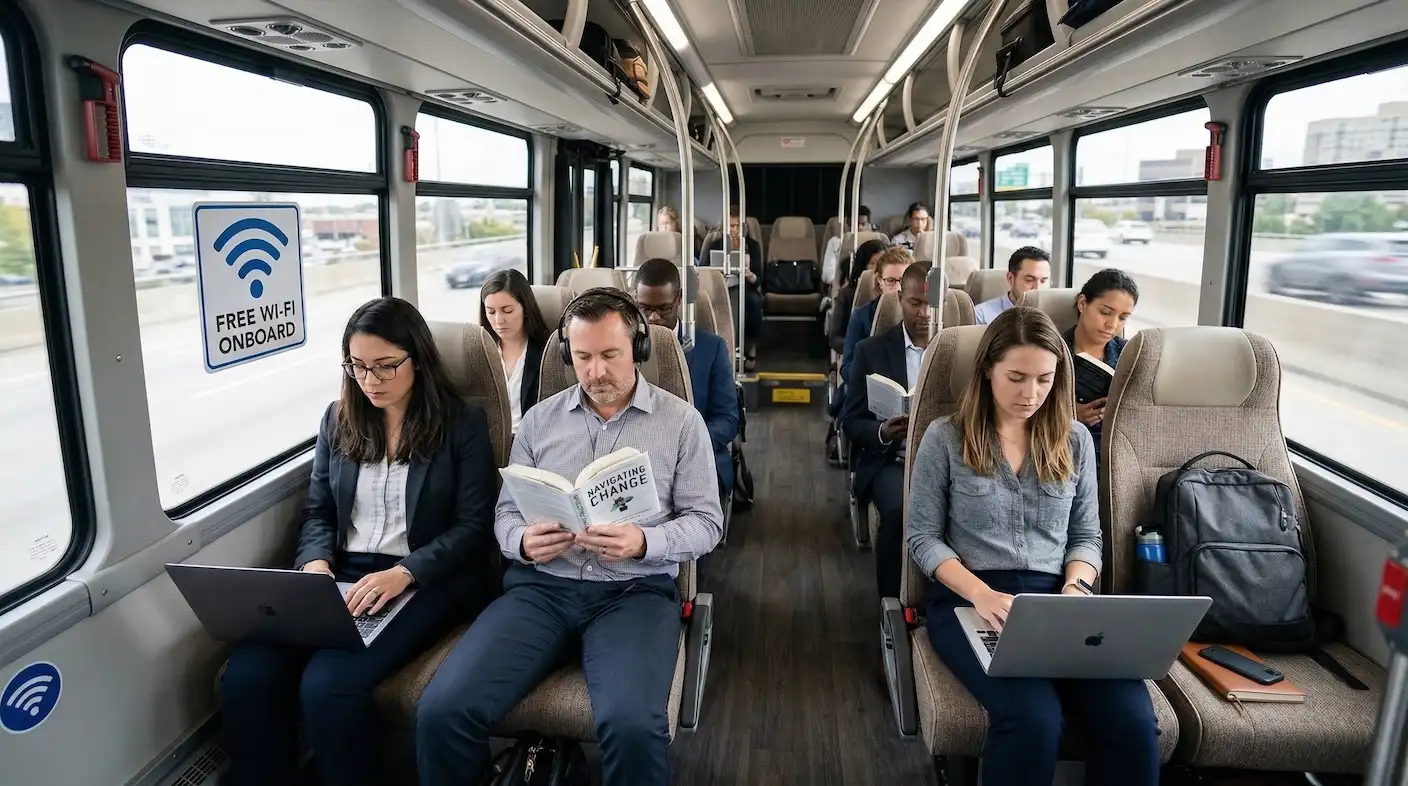
Productivity recovery. Long or unreliable commutes cost more than most companies account for. Employees who arrive stressed, late, or mentally depleted aren’t performing at the level of employees who spent their commute reading, resting, or preparing for the day. The math is straightforward once you assign a value to a focused versus distracted first hour of work.
Recruitment and retention. The evidence here is direct: employees consistently cite workplace transportation benefits as factors in accepting — and staying at — jobs. In competitive hiring markets, a corporate shuttle program is a visible, recurring signal that the company invests in its people. One corporate shuttle client put it simply: “The shuttle contributed to my decision to join the company.”
Parking and infrastructure offset. Adding parking capacity is expensive. Reducing the number of employees arriving by private car directly reduces the pressure on parking infrastructure, which has real capital and operating costs. For companies in dense urban areas or campuses with constrained parking, a shuttle program can defer or eliminate significant infrastructure spending.
These three levers — productivity, retention, and infrastructure — give finance a framework. The provider you choose should be able to help you build this case with data from comparable clients.

What to Evaluate in a Corporate Transportation Partner
Once the business case is approved and you’re evaluating providers, the conversation quickly moves beyond vehicles and routes. Here’s what actually differentiates a good partner from a mediocre one.
Fleet condition and maintenance. Ask how frequently vehicles are inspected and who performs the maintenance. Providers who manage their own maintenance in-house — rather than outsourcing it — tend to have faster response times when something goes wrong. A breakdown on a Tuesday morning that leaves 60 employees stranded is not a minor inconvenience; it’s a visible failure with real operational consequences. Ask directly: what is your average vehicle age, and what is your backup protocol when a vehicle is unavailable?
Driver qualifications and vetting. The minimum standard varies by jurisdiction, but you should ask specifically about the licensing requirements your provider holds their drivers to, how drivers are recruited and background-checked, and what ongoing training looks like. Drivers are the most direct point of contact between your employees and the service. How they behave, communicate, and handle problems matters as much as whether the vehicle arrives on time.
Technology and visibility. A corporate transportation partner in 2025 should offer real-time GPS tracking, a management dashboard that shows route performance and punctuality data, and some form of employee-facing app or booking system. If a provider can’t show you ridership analytics, on-time performance reports, or historical data from comparable routes, that’s a gap worth pressing on. Operational transparency isn’t a feature — it’s a basic expectation.
Flexibility as your needs change. Routes need to change when employees move, offices expand, or shift patterns shift. Ask how the provider handles route modifications: what lead time do they require, what’s the process, and are changes included in the base contract or priced separately? A provider that charges significant fees for any adjustment creates friction that will frustrate your team over a long contract.
Contract structure and exit terms. Most corporate shuttle contracts run 12 to 24 months. Understand what happens if your headcount drops significantly, if you need to pause service during a company restructuring, or if the service consistently fails to meet the agreed standards. A provider confident in their service will have reasonable exit terms. Vague language around performance guarantees and contract termination is worth scrutinizing before you sign.
Questions to Ask Before You Commit
These are the questions that separate a polished sales presentation from an honest conversation about capability.
- What is the average on-time rate across your current routes, and can you share data from the last 90 days?
- What happens when a driver calls in sick or a vehicle breaks down 30 minutes before a route is scheduled to run?
- Can you share references from clients with similar operational profiles — similar headcount, shift patterns, or geographic footprint?
- How is route optimization handled as ridership patterns change over time?
- What does your reporting dashboard show, and how often is data refreshed?
- If we need to add a new pickup point or adjust a route, what’s the typical turnaround time?
- What is your driver retention rate? High turnover in driver staff typically produces inconsistent service.
The answers to these questions reveal more than any brochure. A provider who hesitates on the on-time rate data or who can’t offer references is telling you something.
Red Flags Worth Taking Seriously
Pricing that seems too low. Corporate transportation is a labor and capital-intensive service. Extremely competitive pricing usually means something is being cut — vehicle maintenance cycles, driver compensation, insurance coverage, or management oversight. Any of these eventually shows up as service quality problems.
No clear performance guarantees in the contract. If the contract doesn’t specify what on-time performance looks like and what happens when that standard isn’t met, you have no leverage when things go wrong.
Vague answers about backup capacity. Every serious provider has a protocol for vehicle failures and driver absences. If the answer is “we handle it case by case,” that’s not a protocol — it’s improvisation.
A one-size-fits-all route proposal. A provider who sends you a standard route proposal without asking detailed questions about your employee locations, shift patterns, and operational constraints isn’t designing a solution for you. They’re retrofitting you into something they already have.
No technology beyond a phone number. If the primary interface for managing the service is a phone call to an account manager, that’s a sign the operation isn’t built for scale or visibility.
Managed Transportation vs. Self-Operated: A Quick Framework
Some organizations at scale consider operating their own fleet rather than contracting a provider. This path offers maximum control but brings significant operational complexity: vehicle acquisition, maintenance management, driver hiring and compliance, insurance, routing software, and day-to-day dispatch.
For most companies, the math favors a managed partner, particularly in the early stages. The break-even point — where the overhead of self-operation becomes worthwhile — typically requires very high daily ridership, multi-site operations, or specific operational requirements that no external provider can meet.
The more productive question isn’t whether to self-operate, but whether your provider is genuinely managing the service or simply supplying vehicles and drivers and leaving the coordination to you. That distinction matters more than the ownership structure.
Building a Program That Actually Gets Used
The best corporate transportation solution in the world doesn’t work if employees don’t use it. Adoption rates are the metric that ultimately determines whether the program delivers its projected ROI.
Communicate the benefit clearly and early. Employees who don’t know about the shuttle, who find the app confusing, or who aren’t sure whether the route covers their neighborhood will default to driving. A structured launch — with clear information, a pilot period, and feedback mechanisms — consistently produces better adoption than a quiet rollout.
Route design is the most important adoption factor. A shuttle that requires a 15-minute detour to reach the pickup point will be used by employees with no other option and avoided by everyone else. Work with your provider to design routes around where employees actually live, not where it’s convenient to place a pickup point.
Collect data after launch and act on it. Ridership patterns shift. Some routes will underperform expectations; others will hit capacity. Providers with real-time analytics make it possible to optimize continuously rather than locking in a configuration that slowly drifts out of alignment with employee needs.
The companies whose shuttle programs become a genuine workplace benefit — the kind employees mention when recommending the company to friends — are the ones that treat transportation as an ongoing service to be managed, not a contract to be signed and filed.