Tabla de contenidos
The question what is a dispatcher usually gets answered from a career-guide angle: salary ranges, how to get hired, what a 911 operator does. This is the answer from the other chair, for the person running a transport company who needs to know what the role controls, what it costs to get wrong, and how many of them the operation actually needs.
What a dispatcher is
A dispatcher is the person who assigns drivers and vehicles to scheduled work and keeps that plan running as conditions change during the day. In a passenger transport company the role sits between the timetable and reality: the schedule says what should happen, and the dispatcher makes what actually happens resemble it as closely as possible.
The title travels across industries and means different things in each. In emergency services a dispatcher receives calls and sends police, fire or medical units, which is the version that dominates most search results. In trucking, a dispatcher matches loads to drivers and manages delivery windows. In passenger transport the object being dispatched is a scheduled departure with people already holding tickets, and that difference changes the pressure profile of the job entirely: there is a fixed time, a fixed place, and a group of customers who will all notice simultaneously if it slips.
What a dispatcher does in a passenger operation
The job breaks into two halves that require different temperaments, which is one reason it is hard to staff.
Before the day starts, the dispatcher builds the assignment: which driver takes which run, which vehicle goes to which route, and how the gaps left by absences, vacations and training get covered. In unionized operations this has to follow the labor agreement precisely, including seniority order for overtime and rest rules between shifts. Getting it wrong creates a grievance, not just an inconvenience.
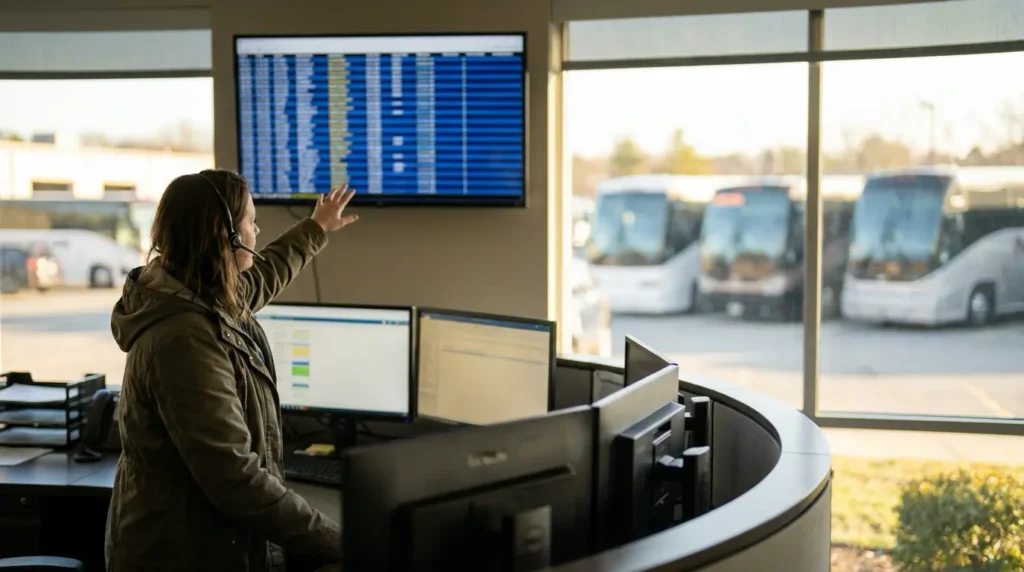
Once the day is running, the role becomes real-time control. Transit agencies often call this function the controller, and in larger operations it is a separate seat. The work includes:
- Monitoring departures and arrivals against the schedule and intervening when a run falls behind.
- Responding to breakdowns, accidents and incidents, and coordinating a replacement vehicle or a relief driver.
- Reassigning equipment when a coach comes out of service, including swapping vehicle types when a departure sells beyond the capacity originally allocated.
- Adjusting service levels or headways when road conditions, weather or a road closure make the published plan impossible.
- Logging everything, because the incident record, the duty hours and the vehicle assignment all become documentation later.
The extraboard, and why it is the hardest part of the job
Most of a dispatcher’s difficulty concentrates in one place: covering work that has no assigned driver. The pool of drivers held in reserve for this is usually called the extraboard or spare board, and managing it is a daily optimization problem with legal constraints attached.
Every assignment out of that pool has to respect rest requirements and cumulative duty limits, follow the seniority rules for how extra work is offered, and still fill the departure. A dispatcher who covers a run by giving it to a driver who has not had enough rest has not solved the problem. They have created a violation that will surface in an audit, and put a fatigued driver in front of 40 passengers.
Undersizing the extraboard is the most common structural error. An operation that staffs exactly enough drivers for its scheduled runs is one flu season away from cancelling departures, and cancellations damage the metrics that matter more than the cost of the standby driver ever did.
Dispatcher, fleet manager, operations supervisor
These three roles overlap enough that small companies often collapse them into one person, which works until it does not.
The dispatcher works in hours and minutes. Their horizon is today and tomorrow, and their output is a departure that leaves on time with a legal driver in a roadworthy vehicle.
The fleet manager works in weeks and months. Maintenance planning, vehicle acquisition and disposal, cost per unit. If you want the distinction in one line, fleet management decides what vehicles exist and what condition they are in; dispatch decides where they go this morning.
The operations supervisor works in the field rather than at a console, responding to incidents in person, checking service on the road, and handling driver performance issues that need a conversation rather than a radio call.
In a 10-vehicle operation one person may hold all three. The failure mode is predictable: the urgent work of dispatch consumes the entire day, and the planning work quietly stops happening until a maintenance backlog or a scheduling problem forces it back.
What makes a good dispatcher
The profile is unusual because it combines two skill sets that rarely sit in the same person.
The first is procedural discipline: knowing the rest rules, applying the labor agreement consistently, keeping records that hold up months later. The second is composure under compression, because on a bad morning the decisions come faster than the analysis can, and a dispatcher who freezes when three things break at once creates a worse outcome than one who makes a defensible choice quickly.
Two other qualities matter more than they appear to. Geographic and network knowledge, because knowing that a particular relief point is 25 minutes away in traffic is the difference between a workable plan and a fantasy. And credibility with drivers, since a dispatcher spends the day asking people to do things outside their assignment, and the ones drivers trust get cooperation instead of a rulebook.
How many dispatchers does an operation need
There is no clean ratio, because the driver is coverage hours rather than vehicle count. What determines the answer is how long the service day runs and how many simultaneous events the dispatcher has to handle.
A small operation running 10 to 15 coaches on a single daytime service window can generally be dispatched by one person, with a second trained to cover absence and peak. An operation running departures from before dawn until late at night needs coverage across those hours regardless of fleet size, which usually means three people once rest days are counted. Once the network spans multiple terminals or the volume of simultaneous incidents grows, the real-time control function tends to separate from the assignment function and become its own seat.
The signal that you are understaffed is not the dispatcher complaining. It is departures leaving late for reasons nobody logged, because the person who should have logged them was on the phone solving the next problem.
What changes when dispatch runs on a system
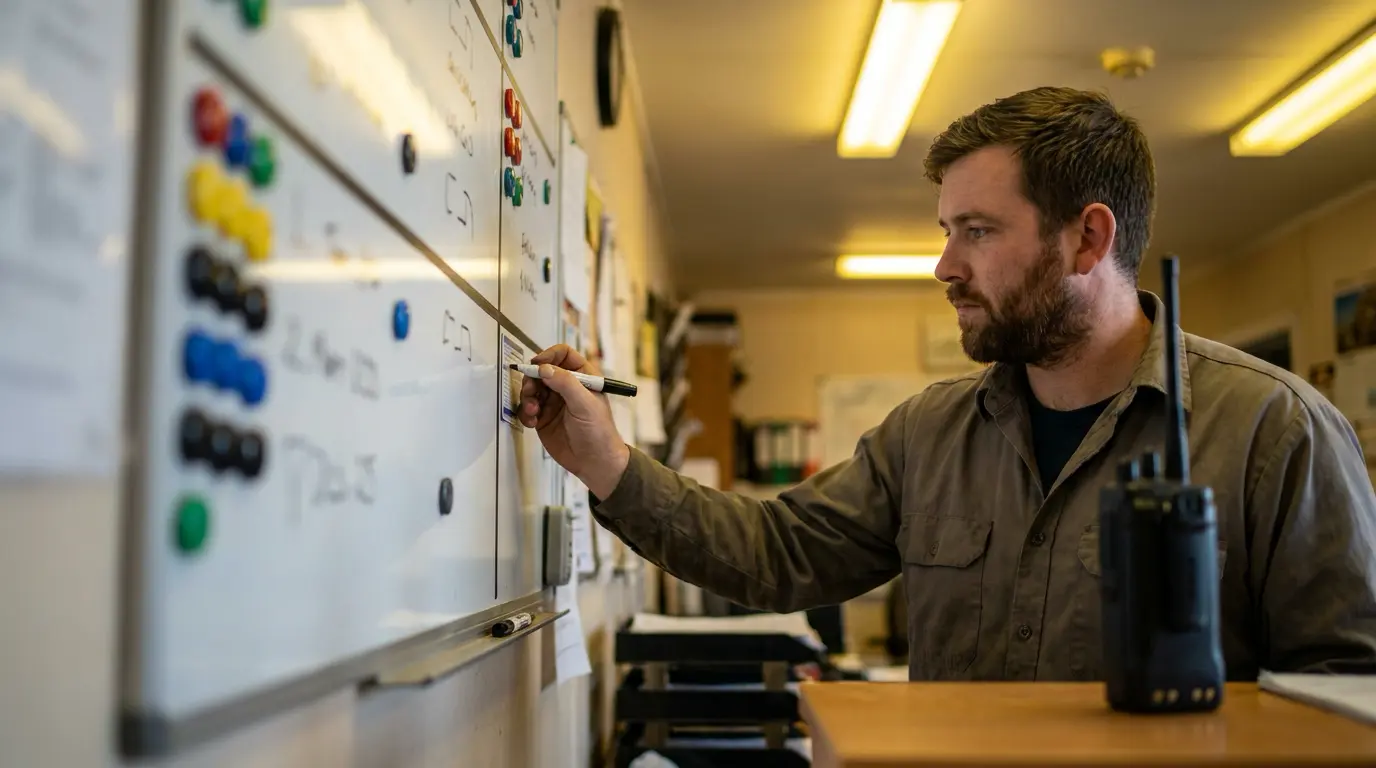
Historically dispatch was a board, a radio and a phone. Large transit agencies moved to specialized platforms decades ago, and the intercity sector has been slower, with plenty of operations still running assignment on paper and coordination over WhatsApp.
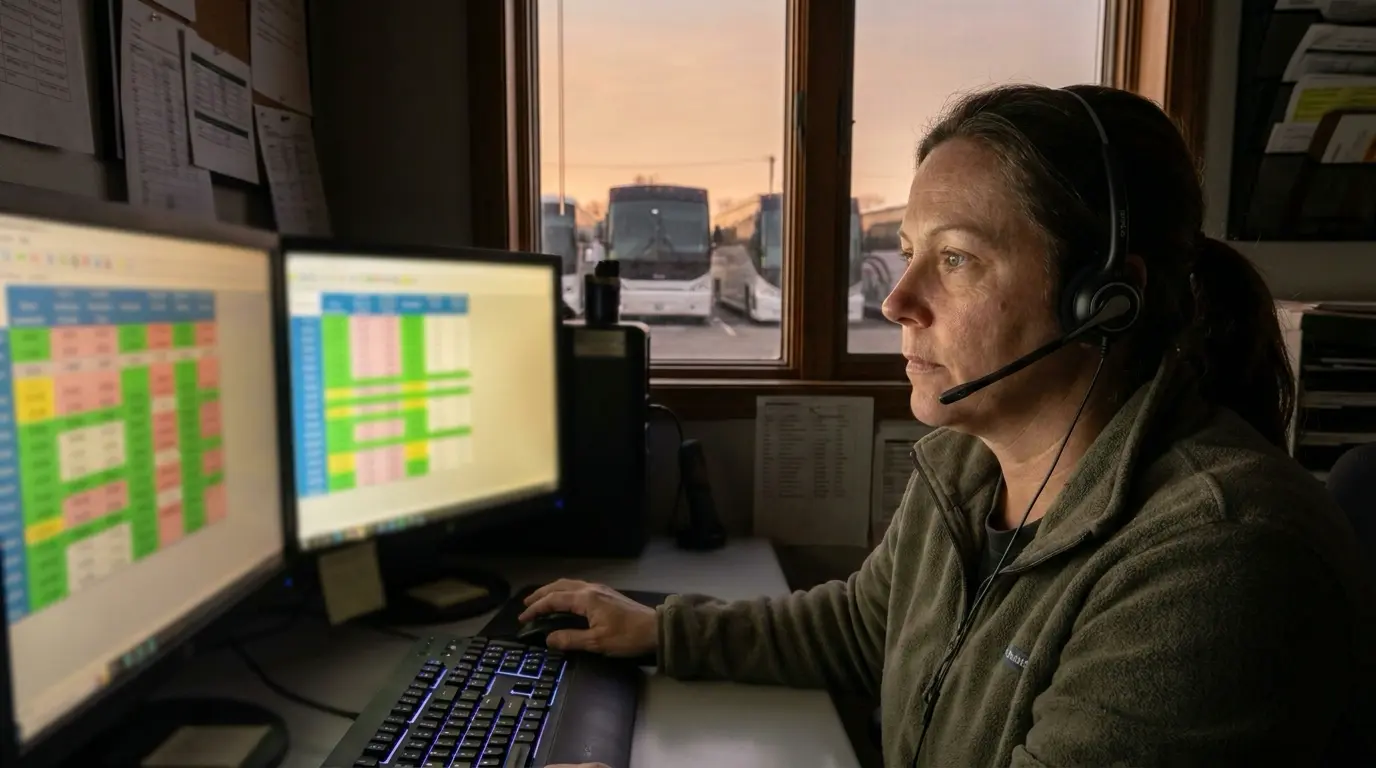
The change software makes is not that it dispatches for you. It is that the information the dispatcher needs to decide stops being something they have to remember or phone someone to find out. Rest hours already accumulated, which vehicles are actually available, which departures are selling beyond expectation, where each coach is right now: when all of that is on one screen, the decision takes thirty seconds instead of six phone calls.
It also converts the work into a record. Assignments, incidents and duty hours logged as they happen become the raw material for operational metrics and for compliance documentation, rather than something reconstructed from memory at month end. Pair that with schedule and route planning and the dispatcher spends less of the day absorbing the consequences of a timetable that never worked.
The role does not disappear. Judgment about which departure to protect when two need the same vehicle is not a scheduling algorithm, it is a commercial decision made in ninety seconds by someone who knows the network. What changes is how much of the shift that person spends gathering information instead of using it.
If your dispatch currently runs on a whiteboard, a phone and one person’s memory of who is rested, consolidating assignment, fleet status and duty hours in a transport management system is where the improvement comes from. See how the platform works.