Tabla de contenidos
- The core components of a bus driver training program
- Federal requirements: ELDT and the passenger (P) endorsement
- The theory curriculum: what drivers must learn
- Behind-the-wheel (BTW) training: range and road
- What separates top programs from compliance-only programs
- How long it takes and how much it costs
- Choosing an FMCSA-approved training provider
- Ongoing training after certification
- Frequently asked questions
Yet most articles about a bus driver training program are written for driver candidates browsing schools or for school districts hiring instructors. Almost nothing exists for the fleet operator — the charter, motorcoach, or transit company owner who has to decide whether to build a program in-house, partner with a registered provider, or sponsor candidates through external schools. That’s the gap this article fills.
If you operate buses, what your training program includes determines two things: whether your drivers are legally allowed to test for their CDL with passenger endorsement, and whether they’re actually safe to put behind the wheel of a 40-foot coach with 50 passengers on board. Those are not the same thing.
The core components of a bus driver training program
A bus driver training program includes three core components: theory instruction (classroom or online), behind-the-wheel training (range and road practice), and ongoing professional development after certification. Since February 2022, the FMCSA’s Entry-Level Driver Training (ELDT) regulations under 49 CFR Part 380 mandate specific theory and behind-the-wheel curricula for first-time CDL applicants and for anyone adding a passenger (P) or school bus (S) endorsement.
Theory instruction covers regulations, vehicle systems, safety protocols, and operational knowledge. Behind-the-wheel training covers range maneuvers (controlled environment) and road driving under instructor supervision. Both must be completed before the candidate can take the state-administered CDL skills test. Programs that go beyond compliance also include defensive driving, customer service, emergency response, and fatigue management modules that the federal baseline does not require but that distinguish a competent driver from a certified one.
Federal requirements: ELDT and the passenger (P) endorsement
The ELDT regulations apply to anyone obtaining a Class A or Class B CDL for the first time, upgrading from Class B to Class A, or adding a passenger (P), school bus (S), or hazardous materials (H) endorsement. For bus operators, the relevant track is Class B (the most common for transit and motorcoach) or Class A combined with the P endorsement.
The passenger endorsement is required for any commercial motor vehicle designed to transport 16 or more passengers including the driver. That covers motorcoaches, transit buses, intercity buses, and most charter vehicles. Without the P endorsement, even a Class B CDL holder cannot legally operate a passenger bus.
Training must be delivered by a provider listed on the FMCSA’s Training Provider Registry. Self-taught or unlisted training does not satisfy the requirement, and state DMVs verify ELDT completion before scheduling the skills test. For operators sponsoring drivers, this means the provider selection is not optional and not negotiable. It must be a registered entity.
The regulations are not retroactive. Drivers who held a CDL or P endorsement before February 7, 2022 are not required to complete ELDT for the same credentials. New hires, however, almost always are.
The theory curriculum: what drivers must learn
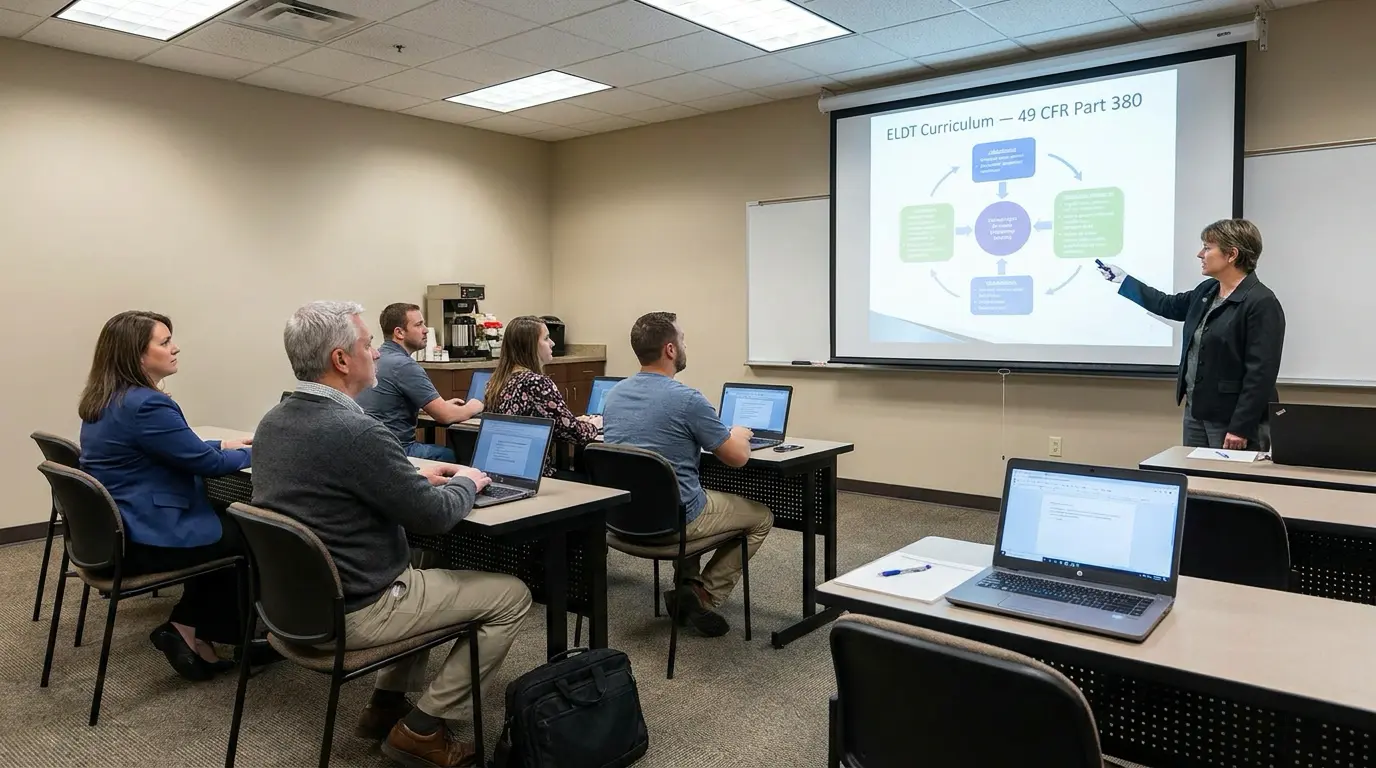
The theory portion of an ELDT-compliant program covers the curriculum defined in Appendices A through E of 49 CFR Part 380, with each appendix tied to a specific CDL class or endorsement. For a passenger endorsement candidate, the theory module includes:
- Vehicle systems and pre-trip, en-route, and post-trip inspections
- Hours of service regulations and electronic logging devices
- Cargo securement (for relevant vehicle types)
- Passenger management, including boarding, alighting, and managing disruptive behavior
- Post-crash procedures and emergency evacuation protocols
- Hazardous materials awareness
- Distracted driving, fatigue, and impairment recognition
- Vehicle handling under adverse conditions (weather, mountain driving, night operations)
Theory instruction can be delivered online, in person, or in a blended format. Under ELDT, the candidate must score at least 80% on the theory assessment to proceed to behind-the-wheel training. The Training Provider Registry confirms completion before the state DMV will schedule the skills test.
For the operator, the theory curriculum is the cheapest and most scalable part of the program. Online providers offer passenger endorsement theory courses starting around $125, which makes sponsoring multiple candidates economically feasible. The real investment comes next.
Behind-the-wheel (BTW) training: range and road
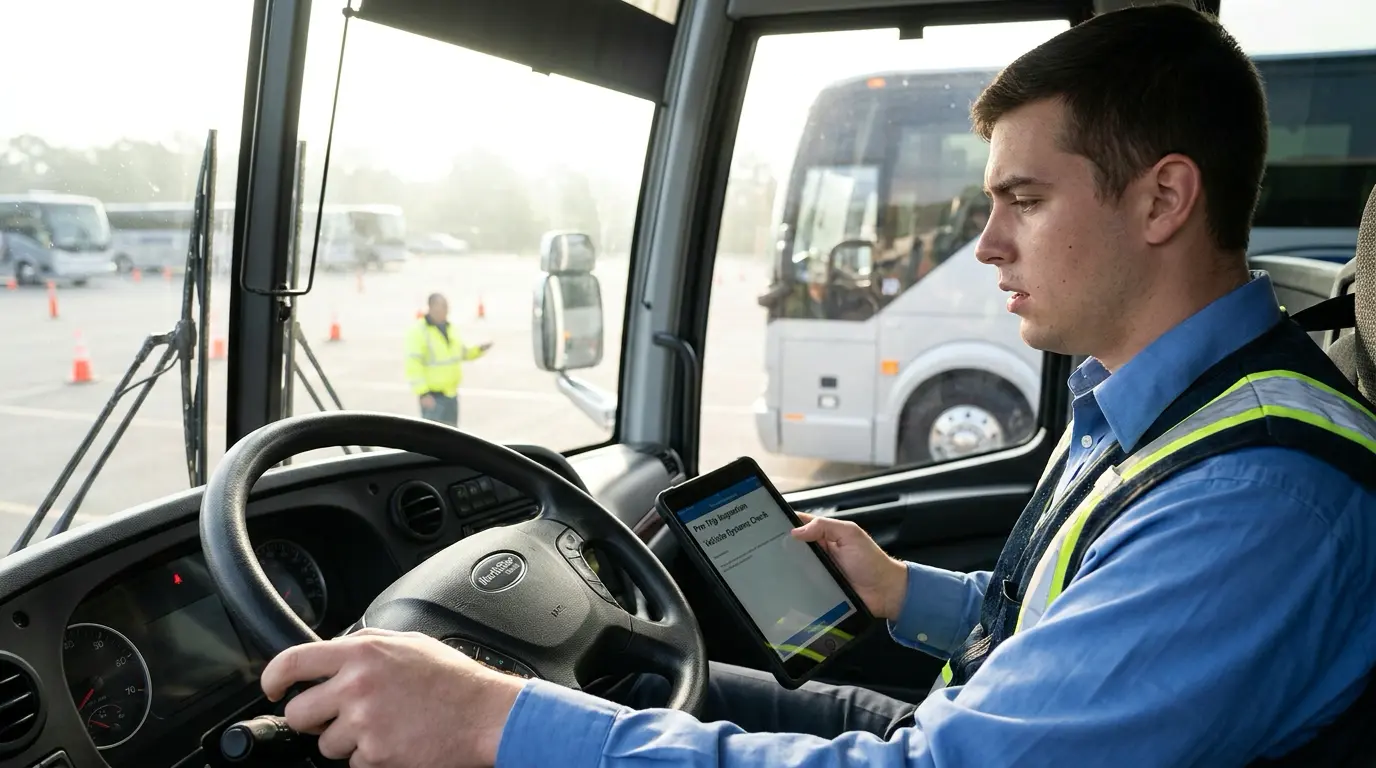
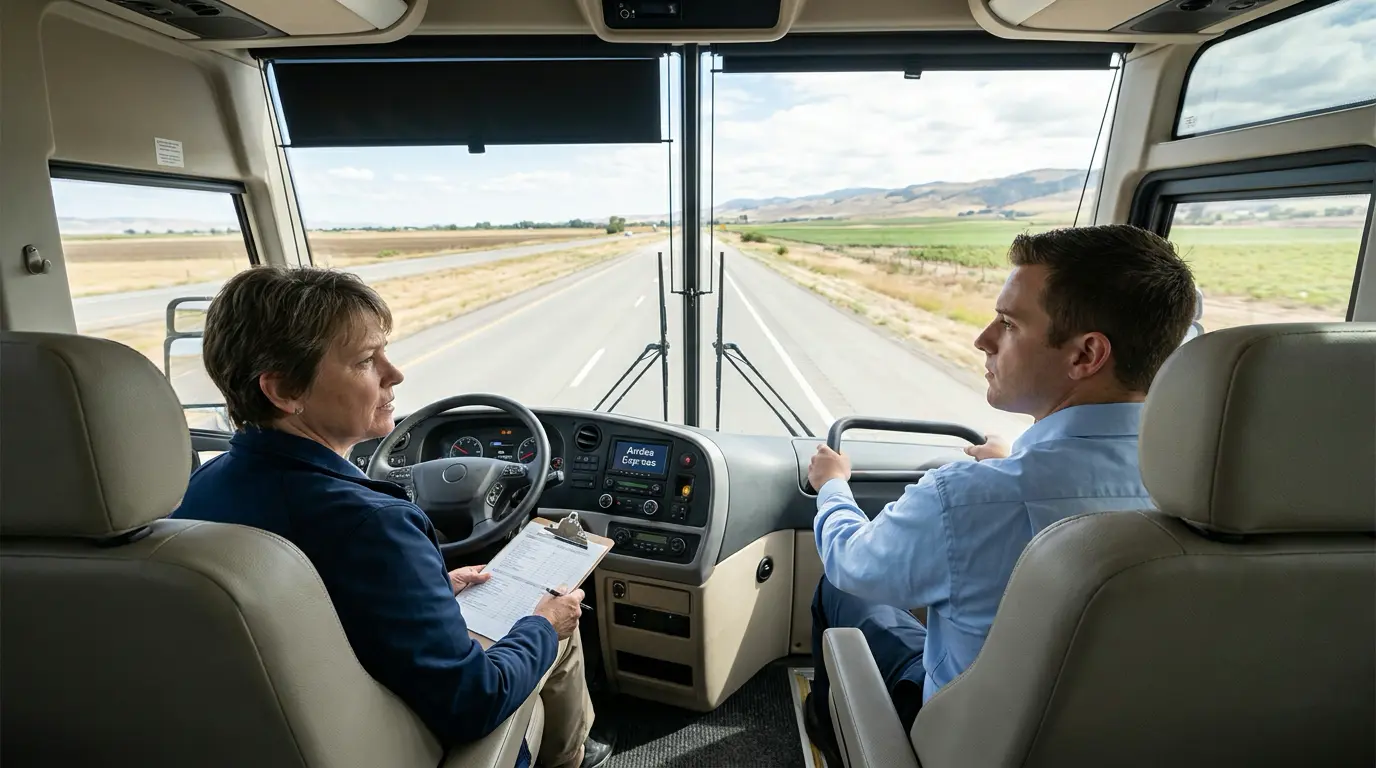
BTW training is where the program separates serious operators from cost-cutters. It consists of two parts. Range training takes place in a controlled environment and covers backing maneuvers, turning, coupling and uncoupling (for Class A), and basic vehicle control. Road training takes place on public roads under instructor supervision and covers real-world driving conditions.
The FMCSA does not specify a minimum number of BTW hours. Proficiency is determined by the instructor’s assessment of the candidate’s performance against the required curriculum elements. In practice, most state-approved Class B with passenger endorsement programs run 80 hours total (theory plus BTW), completed over two weeks of full-time training. Class A programs typically run longer, around 4.5 weeks for the combined CDL with passenger endorsement.
For a fleet operator deciding between sponsoring candidates through external schools or running an in-house program, BTW is the variable that drives the decision. External providers charge $3,000–$4,800 per candidate for a Class B + P program in most states. An in-house program requires registered instructors, dedicated training vehicles, range access, and curriculum documentation. The crossover point, when in-house becomes cheaper than external sponsorship, typically sits around 15–25 new drivers per year, depending on the state and labor costs.
What separates top programs from compliance-only programs
ELDT is a floor, not a ceiling. A driver who completes a compliance-only program has the legal credentials to operate a passenger bus but may not be ready to handle the situations that define real-world bus operations. Top operators build training programs that include the following modules.
Defensive driving and risk awareness
Defensive driving training extends beyond ELDT’s basic safe-driving content into proactive hazard recognition. Topics include scanning patterns, following distance management for heavy vehicles, mountain and grade driving, urban congestion navigation, and high-speed corridor operations. A motorcoach operator running mountain routes needs a driver who has practiced descent strategies, not just one who has passed a written test.
Customer service and passenger interaction
Federal curriculum touches passenger management but doesn’t address customer service. A driver represents the company to every passenger on every trip. Top programs train on de-escalation techniques, handling complaints, managing passengers with disabilities or special needs, professional appearance, and communication standards. These soft skills often determine whether a passenger rebooks with the company or files a complaint.
Emergency response and post-crash procedures
The federal baseline covers post-crash procedures conceptually. Top programs add hands-on simulation: evacuation drills with passengers, fire extinguisher use, first aid certification, communication protocols with dispatch and emergency services, and post-incident documentation. For an operator, a driver who handles an emergency competently can be the difference between a contained incident and a litigation event.
Fatigue management and hours of service
Hours of service regulations are covered in theory, but practical fatigue management is operational. Top programs train drivers to recognize early fatigue indicators, structure rest during multi-day trips, manage scheduling conflicts, and use logging devices accurately. For operators running long-haul charter or overnight intercity routes, this module pays for itself the first time it prevents a single fatigue-related incident.
Operators serious about safety often integrate ongoing telemetry and driver behavior monitoring into training feedback loops. The driver behavior monitoring article we published in March covers how data from the road feeds back into training programs.
How long it takes and how much it costs
A standard Class B CDL with passenger endorsement program runs 80 hours, completed in two weeks of full-time training. Class A programs run approximately 4.5 weeks. Both timelines assume the candidate already holds a Commercial Learner’s Permit (CLP) and meets minimum eligibility (age 18 for intrastate, 21 for interstate, valid medical certificate, clean driving record).
External program costs vary by state and provider:
- Online theory-only ELDT (passenger endorsement): starting at $125
- Class B + P full program (theory + BTW): $3,000–$4,800
- Class A + P full program: $4,500–$8,000
- DMV testing and credentialing fees: $42–$250 depending on state
These are sticker prices for the candidate. Operators sponsoring drivers should also factor in the candidate’s compensation during training (most pay either a stipend or full wage for the two-to-five-week training period), housing and transportation if the program is out of town, and the productivity cost of having a new hire off the road for the duration. Total all-in cost per sponsored driver typically lands between $5,000 and $12,000.
(IMAGE 4 GOES HERE)
Choosing an FMCSA-approved training provider
Every program — in-house or external — must be registered on the FMCSA’s Training Provider Registry (TPR) to deliver ELDT-compliant training. For operators evaluating external providers, the selection criteria are:
- TPR registration in good standing (verifiable at tpr.fmcsa.dot.gov)
- Curriculum alignment with the relevant appendix of 49 CFR Part 380
- Instructor qualifications (minimum two years of relevant CDL driving experience, no recent disqualifying violations)
- Training vehicle suitability (matches the class and configuration the driver will operate)
- Range and road access (some providers lease ranges, which can affect scheduling)
- Reporting infrastructure to upload completion records to the TPR within the required window
For operators building in-house programs, the same criteria apply plus the administrative burden of registering, maintaining curriculum documentation, and renewing instructor credentials. Many mid-sized operators choose a hybrid model: theory delivered by an external online provider at low per-seat cost, BTW delivered in-house using company equipment and routes.
Ongoing training after certification
Certification is the start, not the end. Federal regulations require periodic medical recertification (typically every two years), but operationally, top programs run annual or biannual refresher training on safety updates, regulatory changes, and incident-driven topics. Common modules include:
- Annual defensive driving refresher
- Hours of service and ELD recertification when regulations update
- Post-incident retraining for drivers involved in any reportable event
- Route-specific orientation when a driver is assigned a new corridor or vehicle type
- ADA and accessibility training updates
For operators using telemetry and scoring systems, ongoing training is increasingly data-driven. Drivers whose scoring drops below a threshold get targeted retraining on the specific behaviors flagged: hard braking, speeding patterns, distracted driving indicators, rather than generic refresher content. This closes the loop between training, operations, and outcomes.
Frequently asked questions
Is online-only bus driver training enough to get a CDL?
No. Online courses can cover the theory portion of ELDT and prepare candidates for the written CDL knowledge test. Behind-the-wheel training must be completed in person with a registered training provider, and the state-administered skills test requires demonstrating proficiency in an actual vehicle.
Can an existing employee become a bus driver through company-sponsored training?
Yes. Operators sponsor candidates regularly, either through partnered external schools or in-house registered programs. The candidate must still meet baseline eligibility (CLP, medical certification, age and driving record requirements) before training begins.
What’s the difference between Class A and Class B for bus operators?
Class B CDL with passenger endorsement covers most transit and motorcoach operations. Class A is required only for combination vehicles (vehicles with a trailer over 10,000 lbs GVWR), which is uncommon for passenger transport. Most bus operators only need Class B + P.
How often does the curriculum get updated?
The ELDT curriculum in 49 CFR Part 380 has been stable since 2022, but FMCSA periodically issues guidance updates and may revise appendices. Registered providers are required to keep curricula aligned with current federal regulations. Operators should review their training provider’s curriculum annually.
A bus driver training program is no longer just a checkbox. Since 2022, it’s a federally regulated process with clear curriculum requirements, documented completion records, and meaningful consequences for non-compliance. But compliance alone doesn’t produce safe drivers, what an operator adds beyond ELDT is what defines the quality of their fleet. The QuatroBus platform helps fleet operators manage driver records, training documentation, telemetry feedback, and ongoing certifications in a single system, so the training investment translates into a safer, more accountable operation. Explore the platform.