Tabla de contenidos
What Does AI in Transportation Actually Mean?
AI in transportation is the use of machine learning, computer vision, and predictive analytics to automate or improve decisions across mobility and fleet operations. It covers everything from route planning algorithms and predictive maintenance to dynamic pricing, passenger chatbots, and driver safety monitoring. The common thread is data: AI converts the constant stream of signals from vehicles, drivers, and passengers into actions that humans alone could not process at scale.
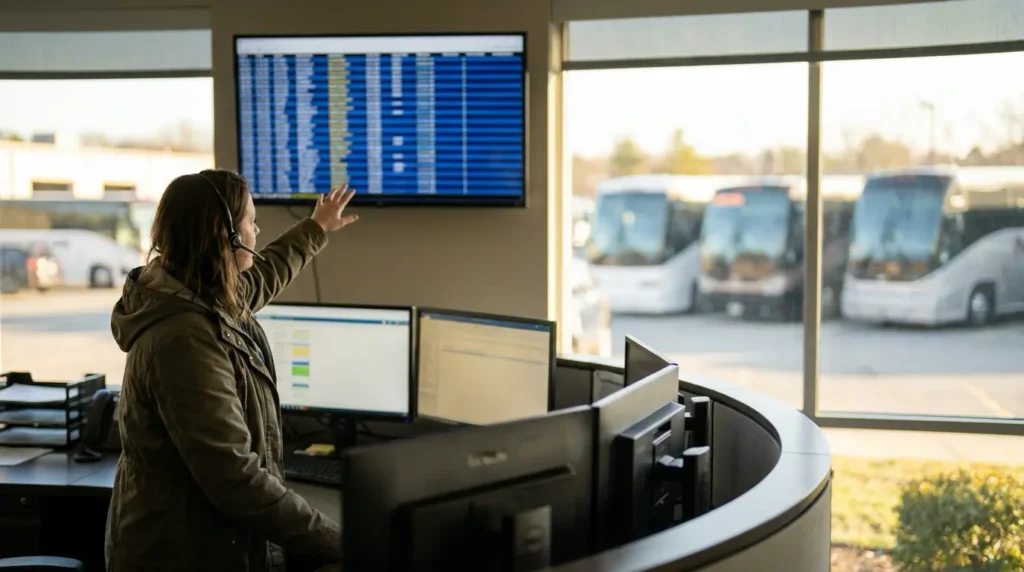
For bus and passenger transport operators, the practical meaning is narrower. AI is not replacing dispatchers or drivers anytime soon. It is augmenting them, by handling the data-heavy work (analyzing thousands of sensor readings, scanning traffic patterns, predicting demand) so that the humans in the operation can spend their time on judgment calls and exceptions.
Six Ways AI Is Already Transforming Fleet Operations
The hype around artificial intelligence in transport tends to focus on what might happen in the future. The more useful question is what is already in production today. These six applications run on real fleets of every size, with documented ROI:
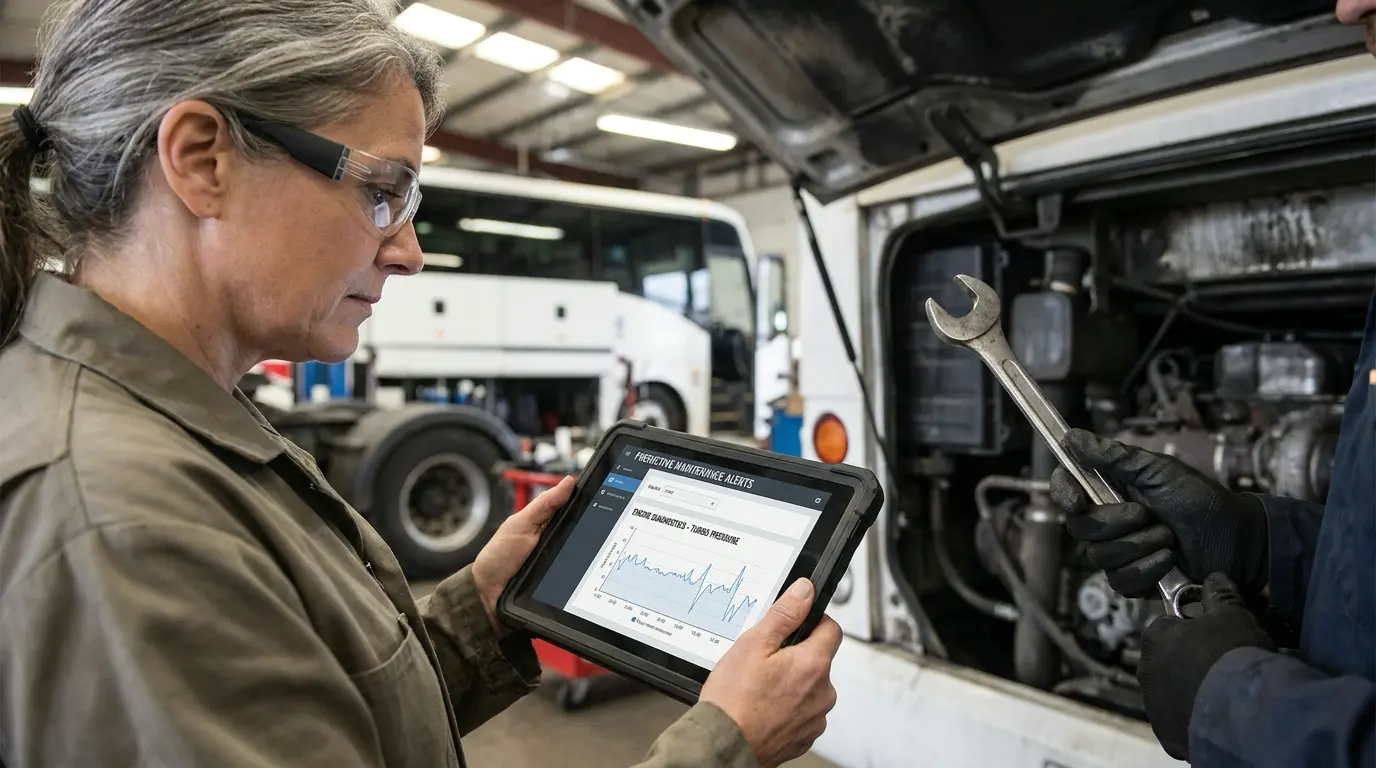
1. Predictive maintenance. Machine learning models analyze engine temperatures, oil pressure, vibration patterns, and fault codes to identify components that are showing signs of failure weeks before they break. According to 2026 data from BusCMMS, bus fleets using AI predictive maintenance see 62% fewer unplanned breakdowns and 30% lower maintenance costs, with payback in 3 to 6 months.
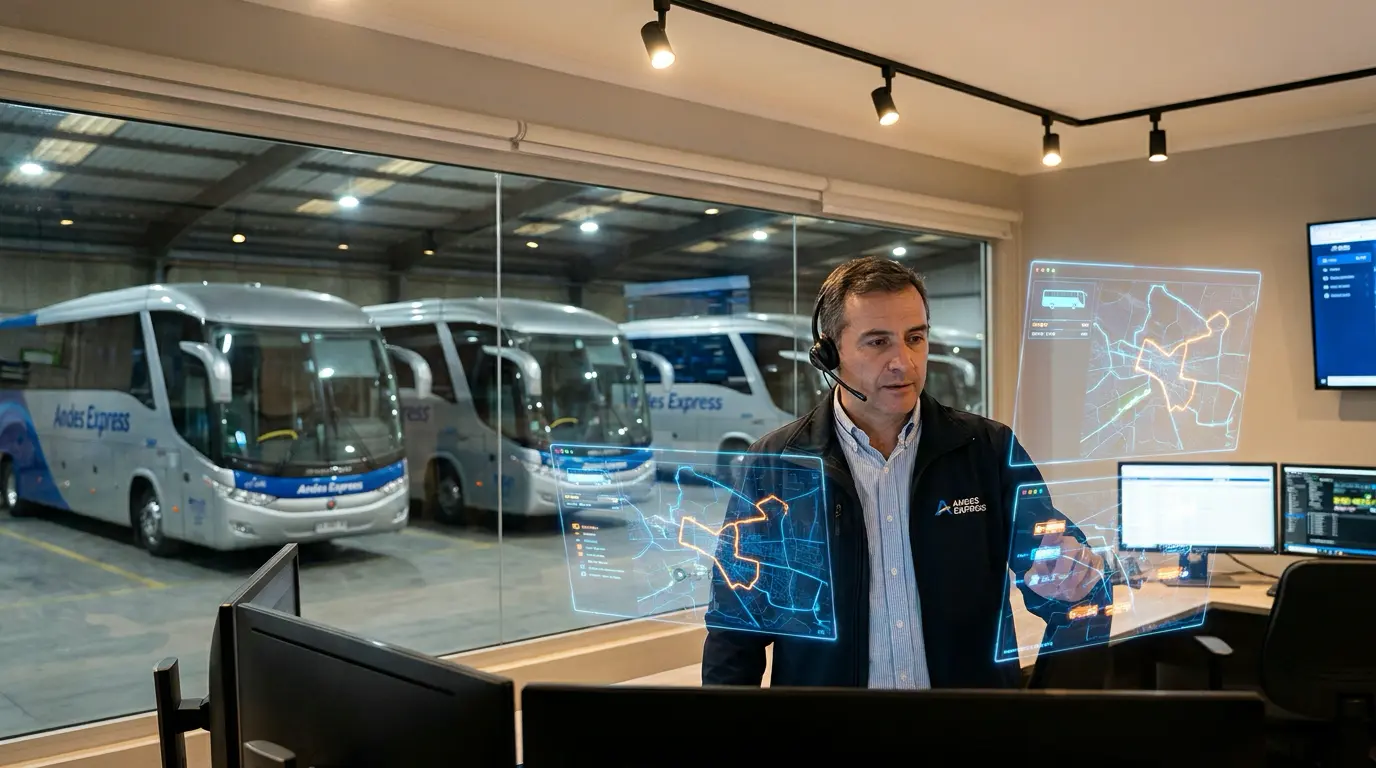
2. Route optimization. AI-driven routing engines evaluate millions of route permutations in seconds, accounting for fuel cost, driver hours of service, traffic, vehicle capacity, and scheduled departures. The specifics of how this works for bus operators differ from delivery fleets, but the savings range is consistent: 10 to 25% lower fuel costs within 90 days of implementation, according to 2026 industry data.
3. Driver behavior monitoring. AI-enabled dash cams and telematics platforms detect harsh braking, speeding, distracted driving, and fatigue in real time. The 2025 Samsara industry report found that fleets deploying full AI safety solutions cut crash rates by 73% over 30 months. The same data feeds into driver coaching programs that improve behavior over time, not just record it.
4. Demand forecasting and dynamic pricing. Machine learning models trained on historical ticket sales, holidays, weather, and external events predict how many passengers will book a given route on a given day. Operators use those forecasts to adjust schedules, position vehicles, and price tickets dynamically. Academic studies on LSTM and BiLSTM models applied to smart-card data show that AI forecasts substantially outperform conventional statistical methods on bus passenger demand.
5. Passenger experience and smart ticketing. AI chatbots handle ticket lookups, route changes, refund requests, and FAQs in multiple languages. Computer vision and natural language processing power smart ticketing systems that detect fraud, manage capacity, and personalize offers. According to the International Association of Public Transport (UITP), close to 90% of public transportation companies are actively developing or implementing AI in everyday processes.
6. Compliance and back-office automation. AI extracts structured data from fuel receipts, maintenance invoices, regulatory filings, and accident reports. That removes hours of manual data entry from dispatchers, accountants, and compliance officers, and the structured output feeds back into the system to improve forecasts and reports.
Each of these is already running on commercial fleets in 2026. None requires a research budget or a team of data scientists. Most run on top of existing telematics hardware.
How Bus Operators Specifically Benefit from AI

Most published case studies on AI fleet management come from trucking, logistics, or last-mile delivery. Bus operators face different constraints, but the wins translate, with some specific advantages.
- Schedule reliability becomes measurable. AI ETA models combine GPS, traffic, and historical run times to give passengers and dispatchers accurate arrival predictions. For interprovincial bus operators, that means fewer angry calls when a coach is delayed and better connection management between departures.
- Empty seats become data, not just losses. Demand forecasting models reveal which routes are consistently under-occupied at which times, giving operators concrete information to adjust frequencies, change vehicle assignments, or run promotional pricing on low-demand departures.
- Driver shortages get partially absorbed. AI dispatch tools assign drivers to routes based on real-time availability, remaining hours of service, and skill matching. Operators report being able to maintain service levels with fewer drivers on payroll because routes are scheduled more efficiently.
- Compliance gets easier. Hours-of-service tracking, vehicle inspection logs, and incident reporting all benefit from AI-driven document processing. The downstream effect is fewer fines, fewer disputes, and less administrative cost per vehicle.
- Maintenance becomes a planned cost. Predictive maintenance is especially valuable for interprovincial fleets because a breakdown on a long-haul route is far more expensive (towing, passenger compensation, lost trips) than the same breakdown on a city route. Catching the failure in the depot is worth multiples more.
The companies that get the most from these tools usually share one trait: they treat AI as a layer on top of clean operational data, not as a magic fix for messy data.
The Real ROI of AI Fleet Management
The ROI conversation has moved beyond projections. The 2025 to 2026 deployment data is specific and consistent across fleet sizes and geographies:
- A 35-vehicle fleet reduced annual maintenance from $620K to $410K in year one using AI predictive maintenance ($210K saved, three times the system cost) per HVI’s published case study.
- A 250-vehicle fleet saved $1.8M annually combining 30% maintenance cost reduction with a 45% downtime decrease, according to FleetRabbit data.
- Industry averages show 10:1 to 30:1 ROI within 12 to 18 months on AI predictive maintenance.
- AI-powered route planning alone can cut fuel consumption and operational costs by up to 50%, according to the 2026 Sustainable Fleets Report.
- The global fleet management market grew from $19.53B in 2024 to a projected $108.7B by 2035, a 14.96% CAGR (Maximize Market Research).
The pattern is consistent: ROI is highest for fleets that are moving from manual processes (spreadsheets, paper logs, calendar-based maintenance) to AI. Fleets already running modern telematics see smaller percentage gains, but still positive returns. The 27% of operators who have already deployed AI hold a 12 to 18 month competitive advantage over the 65% who plan to implement by end of 2027.
Where AI in Transportation Still Falls Short
Most articles on this topic skip this section. They should not. Honest evaluation of limitations is what separates real operators from people selling pilot projects.
- Autonomous bus operations remain limited. Self-driving buses exist in controlled environments (campus shuttles, fixed-route urban pilots), but full autonomous interprovincial coach service is not commercially available in 2026. Conditional automation features (lane-keeping, adaptive cruise control, emergency braking) are mature; full Level 4 or Level 5 autonomy on open highways is not.
- AI is only as good as the data it sees. Garbage data produces garbage predictions. Operators with poorly maintained telematics, incomplete maintenance records, or inconsistent driver logs see weak results regardless of the algorithm.
- Integration is the hidden cost. The headline price of an AI platform is rarely the full cost. Connecting it to existing TMS, ticketing, accounting, and HR systems usually costs as much as the platform itself.
- Edge cases break models. AI is excellent at common situations and weak at rare ones. A predictive maintenance model trained on diesel coaches will not predict failures correctly on a recently added electric fleet. Models need retraining as the operation changes.
- People resist tools they did not choose. Even the best system fails if dispatchers, mechanics, and drivers do not use it. Adoption is at least 50% of the ROI, and it depends on training, not on the software.
A 2026 Fleetio benchmark survey found that 53% of fleet managers are researching or piloting AI maintenance, but only 5.6% have deployed it broadly. The gap is not technology. It is integration, change management, and data hygiene.
How to Start Using AI Without Overcommitting
Operators who try to deploy AI across every function at once almost always overspend and underdeliver. A staged approach delivers most of the value with far less risk:
- Pick the highest-value use case first. For most bus operators, that is predictive maintenance or route optimization. Both have the clearest ROI and the shortest payback. Avoid the temptation to start with passenger-facing AI, which is harder to measure.
- Use the telematics you already have. Most post-2018 buses have factory telematics that can feed AI platforms without expensive sensor retrofits. Check what data your current vehicles already produce before buying new hardware.
- Run a 60 to 90 day pilot. A short pilot with a small group of vehicles gives a real baseline. Skip the demo numbers and measure your own.
- Track one metric per use case. Predictive maintenance: emergency breakdowns avoided. Route optimization: fuel cost per kilometer. Driver safety: harsh braking events per 1,000 km. One metric, measured before and after, says more than a 40-slide deck.
- Plan for adoption, not just deployment. Budget for training. Pair early adopters with skeptics. Show the first prevented breakdown or the first fuel savings to the whole team. People follow proof.
- Build on what works. Once one use case is delivering measurable returns, expand. The operators who do this in order, predictive maintenance first, then routing, then safety, then passenger experience, usually finish with a fully integrated AI stack that paid for itself along the way.
The fleets that succeed with machine learning logistics tools are not the ones with the biggest budgets. They are the ones that picked one problem, measured the results, and scaled from there.
Frequently Asked Questions
Is AI going to replace bus drivers?
Not in the near term. Fully autonomous interprovincial bus operations are not commercially available in 2026, and most analysts place practical deployment at least a decade out. AI is currently augmenting drivers with safety systems, route guidance, and fatigue monitoring rather than replacing them.
How much does AI fleet management software cost?
Pricing varies widely. Predictive maintenance platforms start at $20 to $80 per vehicle per month for small fleets. Full AI-enabled TMS suites cost more but include ticketing, fleet management, dispatch, and reporting. Total cost depends as much on integration as on licensing.
Do I need a data scientist on staff to use AI in transportation?
No. Modern AI platforms are designed for operations teams, not engineers. The skills needed are in interpreting the output, working with vendors, and managing the change, not in building models from scratch.
What is the difference between AI and telematics?
Telematics is the data collection layer (GPS, sensors, engine diagnostics). AI is the analysis layer that turns that data into predictions and decisions. Telematics without AI gives you reports; AI without telematics has nothing to analyze.
How long until I see results from AI fleet management?
Most deployments show measurable returns within 30 to 90 days. The first prevented breakdown or the first fuel savings on an optimized route often covers the entire system cost. Full ROI typically arrives in 6 to 18 months depending on the use case.
Most operators do not lose to AI competitors because their fleets are smaller or older. They lose because their routing, maintenance, ticketing, and accounting data live in disconnected systems where AI cannot reach them. QuatroBus brings every operational layer into one platform built for passenger transport, which is the part most fleets get wrong before they ever turn on an algorithm.