Tabla de contenidos
Search for dispatch software for buses and the results will hand you delivery route optimizers, taxi hailing platforms and enterprise transit planning suites. Useful products, all of them, built for problems an intercity bus operator does not have. Your route is fixed and licensed. Nobody needs an algorithm to decide where the coach goes.
What an intercity operation needs is assignment: which unit and which crew cover each scheduled departure, whether they are legally able to, and what happens to everything else when one of them falls through at five in the afternoon.
What dispatch software does
Dispatch software is the system that assigns vehicles and drivers to scheduled work, tracks execution in real time and handles changes while operations are running. It replaces the whiteboard, the spreadsheet and the group chat with a single record of who is covering what, visible to the office and to the crew at the same time.
In delivery and field service, the hard part is deciding the order of stops. In scheduled passenger transport, the stops are fixed by the authorization. The hard part is coverage, eligibility and the chain reaction that follows any change.
Why most dispatch tools do not fit an intercity operation
The category splits into four groups, and three of them solve someone else’s problem.
- Delivery route optimizers build efficient multi stop itineraries. Valuable for parcels in a city, irrelevant for a coach running a fixed corridor on an authorized schedule.
- Taxi and ride hailing dispatch matches an available driver to an immediate request. Passenger transport with reserved seats works the opposite way: the service exists first and sells in advance.
- Driver scheduling apps handle shifts and availability well, but they know nothing about units, maintenance status, route authorizations or tickets already sold.
- Transit planning suites do solve real scheduling problems, with vehicle and duty optimization built for urban networks and public authorities. They are priced and scoped accordingly, which puts them out of reach for an operator with twenty or forty coaches.
That gap is why so many intercity operators still run dispatch on a printed board and a phone. The available tools either do too little or are built for a different business.

What the dispatcher is actually doing
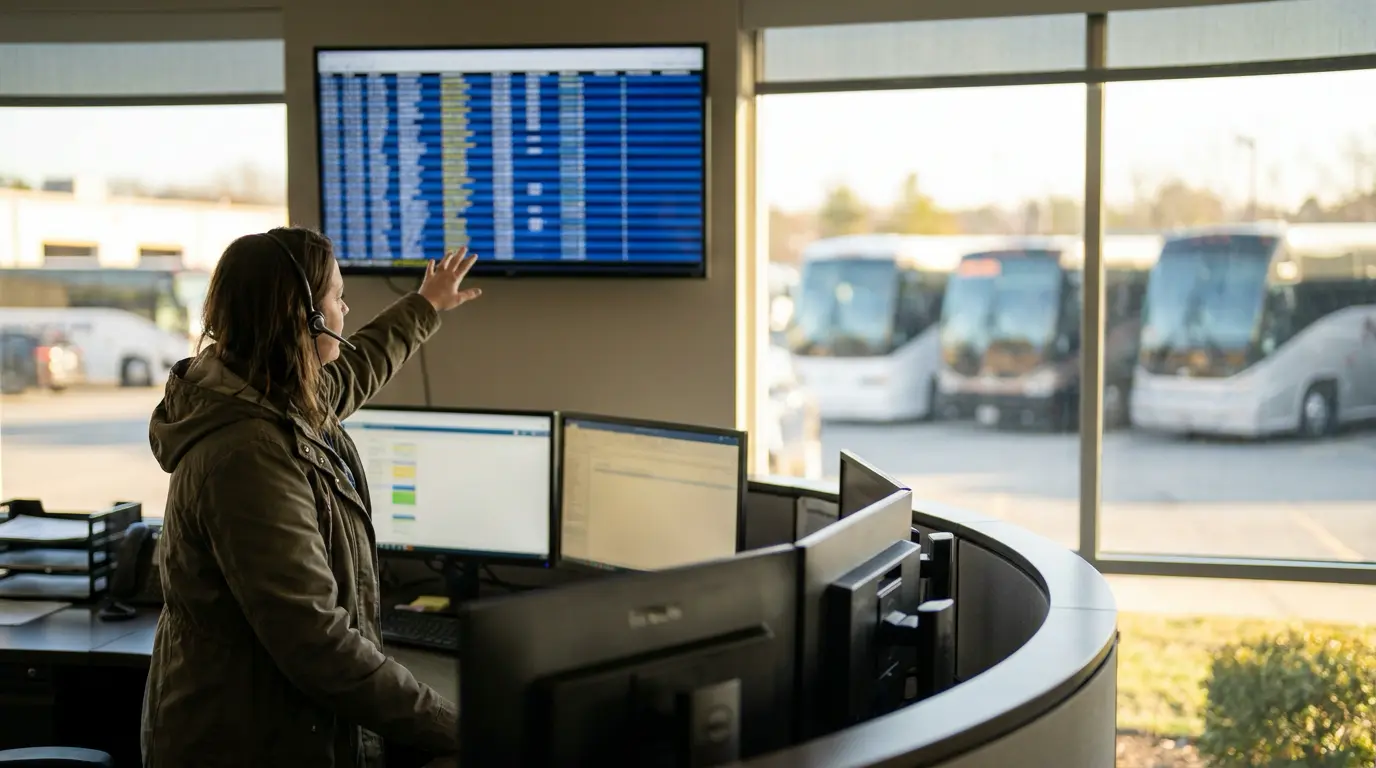
A realistic afternoon in an operations office: eleven departures scheduled between six in the evening and midnight. One driver calls in sick. A unit that was supposed to be back from its maintenance service is still in the workshop. The coach covering the 22:00 is an hour behind on its inbound leg. Two of the eleven services are nearly sold out and cannot be downgraded to a smaller vehicle.
Every decision the dispatcher makes in the next twenty minutes touches four systems at once. Reassigning a unit changes the seat map that the counter is still selling. Changing a driver has to respect rest hours and route qualification. Pulling a coach from tomorrow morning’s service to cover tonight moves a maintenance appointment. And every one of those changes has to reach the crew before they leave the yard.
Software that only holds a driver roster cannot help with any of that. It solves one quarter of the problem and leaves the dispatcher reconciling the other three quarters by phone.
Features that matter for a bus operator
A dispatch tool earns its place in this operation if it covers the following:
- An assignment board organized by departure, not by driver or by vehicle. The unit of work is the service, and everything else attaches to it.
- Crew eligibility rules: license class and expiry, rest hours since the last duty, route qualification, medical certificate validity. The system should refuse an assignment that breaks one of these rather than trusting the dispatcher to remember.
- Unit availability tied to maintenance status. A coach scheduled for service must be unavailable for assignment, without anyone having to check with the workshop.
- Seat map consequences of reassignment. If the replacement unit has a different configuration, the system needs to flag which sold seats are affected before the change is confirmed.
- Live position linked to the service, so the dispatcher sees the inbound leg that will become tonight’s departure, not a generic map.
- Crew notification through a mobile app, with confirmation of receipt. A change nobody acknowledged is not a change.
- Documentation generated from the assignment: manifest and route sheet built from the same record, so the paperwork matches what actually happened.
- An audit trail. Who changed what and when, which is the first thing anyone asks after an incident.
The reassignment problem
Of all of those, the one that separates a real product from a scheduling app is what happens when a unit changes.
Swapping a coach is never an isolated act. The sold seats have to map onto a new configuration. The manifest has to reflect the new plate. The kilometers now belong to a different unit’s maintenance plan. The crew assigned may or may not be qualified on the replacement vehicle. If those four consequences are handled in four different places, they will not all get done, and the one that gets skipped is usually the manifest.
This is the practical argument for keeping dispatch inside the same system that holds ticketing and fleet data rather than beside it. A change made once should propagate. A change made once and then re entered three times will eventually be entered only twice.

Build, buy standalone, or use the module in your TMS
Three paths, with honest trade offs.
Building in house gives an exact fit with your operating rules, which is genuinely valuable in a business full of local exceptions. It also means owning the maintenance of a critical system forever, and dispatch is the kind of software that can never be down during the evening peak.
Buying a standalone dispatch tool is fast and usually cheap. The cost appears later, in the integration work needed so the tool knows about seats sold, maintenance status and crew credentials. Without that, you have digitized the whiteboard and nothing more.
Using the dispatch module of a transport management system gives the shared data model by default, since ticketing, fleet and dispatch already reference the same schedule. The trade off is that you inherit the vendor’s model of how an operation should work, which is worth evaluating carefully against how yours actually works.
There is no universally correct answer, but there is a wrong one: choosing a standalone tool without budgeting for integration and assuming it will connect itself later.
The first thirty days
Dispatch is the hardest module to roll out, because it is the one that cannot pause. A sequence that works:
- Load the schedule of services first, exactly as it is authorized, before touching drivers or units.
- Load crew credentials with real expiry dates. This step usually surfaces two or three drivers with something out of date, which is itself worth the exercise.
- Run parallel for two weeks. Board and system together, with the board as the source of truth, so the team builds confidence without risking a departure.
- Switch the source of truth and remove the board. Keeping both is what kills these rollouts, because staff quietly return to the board under pressure.
- Review the audit trail after the first month to see where changes cluster. Repeated last minute reassignments on the same service usually mean the schedule itself is wrong, not the dispatcher.
What to ask a vendor
- Is the assignment board organized by departure, or by driver?
- Can the system block an assignment that violates rest hours or an expired credential?
- What happens to sold seats when a unit with a different configuration replaces another?
- Does vehicle availability read maintenance status automatically?
- Do crew changes reach drivers with confirmation of receipt?
- Are the manifest and route sheet generated from the assignment, or entered separately?
- What does the audit trail record, and for how long?
Questions three and four are the ones that expose a generic product quickly. A tool built for shift scheduling or last mile delivery has no concept of a seat map or a maintenance plan, and the answer tends to arrive as a promise about a future release.
Dispatch is where schedules, units, crews and tickets meet, and the quality of an operation is mostly decided there. The QuatroBus transport management platform handles assignment inside the same system that holds ticketing, fleet status and parcels, so a reassignment at five in the afternoon updates the seat map, the manifest and the maintenance plan in one move, and the crew finds out before they leave the yard.