Tabla de contenidos
- What Makes Colca Canyon Different from Other Destinations in Peru
- Day Trip vs. Multi-Day Trek: The Question Nobody Answers Clearly Enough
- Altitude: The Part of the Trip That Surprises People Most
- How to Get to Colca Canyon
- Where to Stay
- What to Eat in the Colca Valley
- What to Do Beyond the Condors
- When to Visit
- Practical Details and Costs
That’s how most visits to Colca Canyon actually begin. Not with a dramatic first glimpse from the rim, but with an altitude check and a slow realization that you’ve climbed higher than most of the Alps just to get to the starting point.
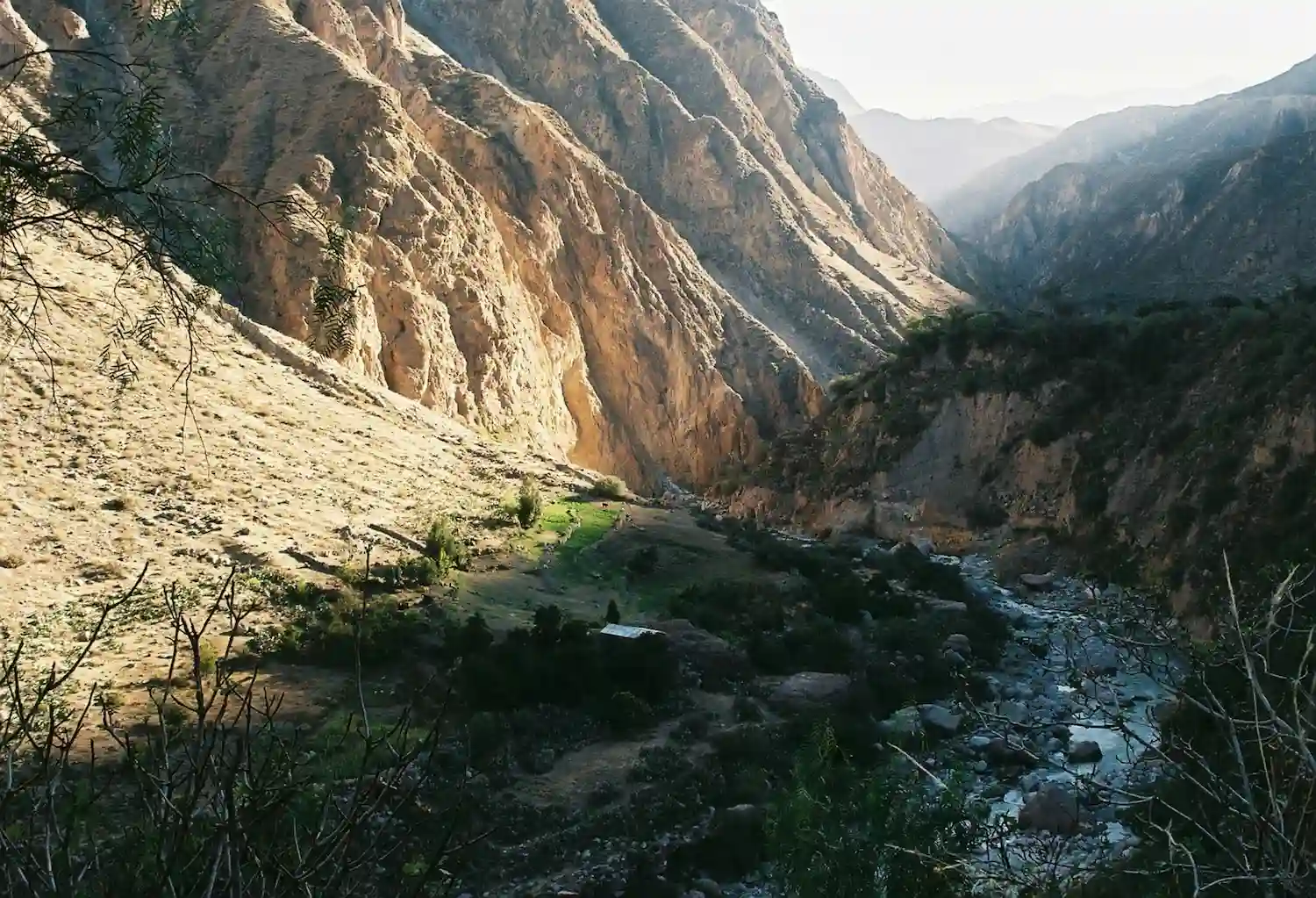
Colca Canyon sits about 160 kilometers northwest of Arequipa in southern Peru. At its deepest point — near the Huambo district in Caylloma province — the canyon drops 3,400 to 3,534 meters from rim to river. That’s roughly twice the depth of the Grand Canyon, which maxes out at around 1,830 meters. Only the Yarlung Tsangpo Canyon in China goes deeper. By any measure, this is one of the most dramatic landforms on earth, and Peru’s third most-visited destination with around 120,000 visitors per year.
But the raw numbers don’t prepare you for what visiting actually involves. That’s what this guide is for.
What Makes Colca Canyon Different from Other Destinations in Peru
Most travelers coming to Peru have Machu Picchu locked in from the start. Colca Canyon is often added to the itinerary as a detour from Arequipa — a day trip, maybe two — and many people underestimate what they’re getting into.
The canyon isn’t just a viewpoint. It’s a living valley. The Collagua and Cabana peoples have farmed these slopes since before the Incas, and the pre-Inca terraces — called andenes — are still cultivated today. Along the valley between Chivay and Cabanaconde, traditions that date back centuries remain intact: distinct hat styles, textile patterns, and dialects that differ community by community.
The town of Chivay sits at the canyon’s midpoint at 3,600 meters elevation and serves as the main base for most visitors. From Chivay, the road continues 26 kilometers downstream to Cruz del Condor — the most famous viewpoint in the canyon and one of the best places in the world to see the Andean condor in flight.
With a wingspan of up to 3.3 meters, the Andean condor is the largest flying bird on the planet. Watching one rise from the canyon walls on thermal currents, wings completely still, is the kind of thing people describe for years afterward. The best sightings happen in the morning hours, usually between 9am and 11am, when thermals build and the birds begin to soar.

Day Trip vs. Multi-Day Trek: The Question Nobody Answers Clearly Enough
This is the decision most guides skip past with a vague “it depends on your fitness level.” Here’s a more useful way to think about it.
The day trip from Arequipa covers the Patapampa Pass, a stop in Chivay for breakfast, the drive to Cruz del Condor, about 40 minutes watching for condors, and a return to Arequipa via the La Calera hot springs — all in around 12 to 14 hours. You’ll see the canyon from above. You’ll probably see condors. You won’t descend into it, and you won’t experience the valley at ground level.
The multi-day trek is a fundamentally different experience. The most common route descends from Cabanaconde into the canyon — around 1,100 meters of vertical drop — reaches the Sangalle oasis at the floor, where a small cluster of guesthouses and natural pools offer a surreal rest stop, and climbs back out the following morning. The full 3-day loop covers roughly 30 kilometers and includes some of the most dramatic elevation changes of any trek in Peru.
If the condors and the views are your priority, the day trip delivers. If you want to understand the scale of the canyon from the inside, the trek is worth the extra day. What it isn’t worth is rushing: anyone who descends to Sangalle and tries to return the same afternoon knows this the hard way.
A practical middle option that many travelers miss: spend one night in Cabanaconde, descend partway into the canyon in the late afternoon, sleep at a guesthouse in the valley, and return in the morning. Less demanding than the full trek, but far more immersive than a day tour.

Altitude: The Part of the Trip That Surprises People Most
Chivay sits at 3,600 meters. The Patapampa Pass — which your bus will cross on the way from Arequipa — reaches 4,910 meters. Arequipa itself is already at 2,335 meters, well above most places where altitude sickness becomes a concern.
The standard advice to spend a day or two acclimatizing in Arequipa before heading to Colca is worth following. Symptoms of altitude sickness — headaches, nausea, shortness of breath, difficulty sleeping — can appear quickly and ruin a trip that looked fine on paper. The coca tea served everywhere in the region is a genuine local remedy, not a tourist novelty.
If you’re connecting directly from Lima (at sea level) to Arequipa and then heading straight to Colca, your body is covering an elevation gain of nearly 4,000 meters in a matter of hours. Give it time. One extra day in Arequipa is a small cost compared to spending your first night in Chivay with a splitting headache.
Children and elderly travelers are more vulnerable to altitude effects. Anyone with a history of heart or respiratory conditions should consult a doctor before planning a visit to Colca.
How to Get to Colca Canyon
From Arequipa
Almost every visitor arrives via Arequipa. From there, the two main options are:
Organized tour: Buses depart from Arequipa around 3am, arriving in Chivay in approximately 3 to 3.5 hours with a stop at Patapampa Pass. Most full-day tours include transport, a bilingual guide, the canyon entrance fee (around 70 soles per person), breakfast in Chivay, and the stop at Cruz del Condor. Return to Arequipa is usually by early evening. Prices typically range from 60 to 120 USD depending on group size and inclusions.
Independent travel: Public buses run from Arequipa’s Terminal Terrestre to Chivay daily, departing in the early morning. From Chivay, local transportation connects to the villages along the valley and to Cabanaconde. This option costs significantly less and gives you more control over timing — important if you’re planning a multi-day trek and want to start at your own pace.
The road between Arequipa and Chivay passes through the Salinas y Aguada Blanca National Reserve, where wild vicuñas roam close to the roadside. It’s a slow-burn preview of the landscape before the canyon itself opens up.
From Lima
Lima to Arequipa is a well-traveled route. You can fly in about 90 minutes, or take an overnight bus — a 16 to 18-hour journey that many travelers find perfectly comfortable on the premium bus services that cover this route. Once in Arequipa, the options above apply.
If you’re combining Colca Canyon with a circuit through southern Peru, a common route runs Lima → Arequipa → Colca Canyon → Puno → Cusco, with overnight buses or flights connecting each leg.
Where to Stay
Chivay is the most practical base. It has the widest range of accommodation — from budget hostels to mid-range hotels with heating (essential at this altitude), as well as restaurants, a market, ATMs, and easy access to transport. It’s the right choice for day-trippers and those doing short canyon excursions.
Cabanaconde is the entry point for serious trekkers. Smaller and quieter than Chivay, it sits at the canyon’s edge with direct access to the main trekking routes. Accommodation is basic but functional, and the views from the village square at sunset are worth the extra hour of driving from Chivay.
Inside the canyon — specifically at the Sangalle oasis — there are several simple guesthouses with natural pools. Staying here means waking up at the bottom of one of the world’s deepest canyons, which is exactly as good as it sounds. Booking ahead is recommended; capacity is limited and the oasis fills up during high season.
For a more comfortable experience, there are a handful of boutique lodges and eco-hotels in the villages between Chivay and Yanque that offer heated rooms, local cuisine, and organized activities. These tend to book out quickly in July and August.
What to Eat in the Colca Valley
The local cuisine of the Colca valley deserves more attention than most guides give it.
Cuy — roasted guinea pig — is the signature dish of Arequipa and the surrounding highlands. It appears on nearly every menu in Chivay and is worth trying at least once if you’re open to it.
Chupe de camarones is a rich shrimp chowder made with local river shrimp from the Colca River, potatoes, corn, and chili peppers. It’s one of the standout dishes in the entire region and something you won’t find in most other parts of Peru.
Rocoto relleno — a stuffed spicy pepper baked with meat and cheese — is another Arequipa regional specialty that appears consistently across valley restaurants. The heat level varies but is rarely subtle.
For breakfast before the condor excursion, most restaurants in Chivay open early enough to serve you before the 8am drive to Cruz del Condor. Quinoa porridge and api morado (a warm purple corn drink) are worth trying over the standard toast-and-eggs options.
What to Do Beyond the Condors
La Calera hot springs, 3 kilometers from Chivay, are a straightforward recovery stop after any amount of hiking. Natural pools sit above the river with views of the surrounding cliffs and cost around 15–20 soles to enter. There are also thermal pools near the village of Yanque, smaller and less crowded.
The colonial churches scattered through the valley villages — Yanque, Achoma, Maca, Pinchollo, Coporaque — were built in the 17th and 18th centuries, many on top of pre-Inca foundations. Yanque’s church is particularly well preserved and houses valuable colonial religious art. The villages are small enough to walk through in an hour but offer a level of quiet and authenticity that Chivay, with its tourist infrastructure, doesn’t quite replicate.
Local markets in the mornings are one of the more grounded cultural experiences in the region. Textiles sold here come from communities that have maintained the same weaving traditions for generations. The hat styles alone — which vary visibly between Collagua and Cabana communities — are a visible marker of how distinct each village remains despite proximity to each other.
For more active visitors, white-water rafting on the Colca River, mountain biking between villages, and horseback riding through the valley are all available through operators based in Chivay. Stargazing, given the altitude and minimal light pollution, is exceptional on clear nights.

When to Visit
The dry season runs from May through October. Skies are clear, trails are solid, and condors are most reliably active. This is the best window for photography, trekking, and getting the most out of Cruz del Condor.
The wet season, from roughly November to April, brings afternoon rains and occasional trail closures. February sees the heaviest rainfall. The upside: the valley turns intensely green, crowds thin out significantly, and accommodation prices drop. Condor sightings become less predictable but not impossible.
For most travelers, the sweet spot is April to June — after the rains have greened the terraces but before the peak dry-season crowds arrive in July and August. September and October are also excellent and slightly quieter than peak summer.
Avoid visiting during the major Peruvian holidays — Fiestas Patrias in late July and the weeks around Christmas and New Year — when transport and accommodation in the whole southern circuit become difficult to book.
Practical Details and Costs
Entrance fee: Around 70 soles per person (subject to change — verify locally).
Altitude reference points: Lima 0m → Arequipa 2,335m → Patapampa Pass 4,910m → Chivay 3,600m → Cruz del Condor ~3,287m → Sangalle oasis ~2,200m
Best condor viewing: 9am to 11am at Cruz del Condor. Condors are less active in the afternoon.
Typical costs:
- Day tour from Arequipa (transport + guide + entrance): 60–120 USD
- Public bus Arequipa–Chivay (one way): around 8–12 soles
- Basic guesthouse in Cabanaconde: 30–60 soles per night
- Sangalle oasis accommodation: 30–50 soles per night (includes pool access)
- Meal at a local restaurant in Chivay: 15–35 soles
Connectivity: Limited phone signal in most of the canyon. Download offline maps (Maps.me or Google Maps offline) before leaving Arequipa.
What to pack: Sunscreen (UV radiation is intense at this altitude), layers for extreme temperature swings between day and night, electrolytes, cash in soles (ATMs beyond Chivay are unreliable), and trekking poles if you’re descending into the canyon.
Cultural note: Ask before photographing local residents, especially during festivals or at the market. A small purchase from a vendor whose portrait you’re taking is a respectful way to acknowledge the exchange.
Colca Canyon rewards preparation and punishes rushing. The travelers who find it underwhelming are usually the ones who showed up for a quick photo at the viewpoint and didn’t know what they were standing above. The ones who spend a night in Cabanaconde, descend into the valley at sunrise, and come back up with their legs aching tend to describe it very differently.