
Tabla de contenidos
During the 2025 International Roadcheck, inspectors across North America placed 18.1% of the commercial vehicles they examined out of service. Brake problems accounted for 41.1% of those vehicle violations, and tires for another 21.4%, according to the Commercial Vehicle Safety Alliance. Neither category shows up overnight. A worn brake lining or a tire running low for weeks is a maintenance schedule that slipped, and a bus parked at the roadside with a full load of passengers is the most expensive way to find out.
Preventive maintenance is how bus operators keep those problems in the shop instead of on the shoulder. This guide covers how a passenger carrier builds a program that actually runs: the layers it needs, what makes it hold up in a federal audit, and the items that matter on a coach but rarely appear in trucking checklists.
What preventive maintenance means for a bus fleet
Preventive maintenance is scheduled inspection and service performed before a component fails, based on mileage, engine hours or calendar time. For a bus fleet it combines daily driver inspections, tiered service intervals in the shop and an annual federal inspection, all documented per vehicle so the operator can prove each coach was maintained on schedule.
The opposite is reactive maintenance: fix it when it breaks. Every operator does some of that, because parts fail unexpectedly. The goal is to shrink it to the small share of failures that no schedule could have caught. If you want to go a step further and service components based on their actual condition, that is predictive maintenance, which builds on a working preventive program rather than replacing it.
The three layers of a preventive maintenance program
A program that works has three layers running at different speeds. Skip one and the other two carry weight they were not designed for.
Layer one: the driver, every day
The pre-trip and post-trip inspections are the fastest feedback loop in the fleet. Federal rules require drivers to confirm the vehicle is in safe condition before operating it, and passenger carriers must complete a driver vehicle inspection report at the end of each day’s work even when no defects are found, a requirement property carriers no longer have. A defect noted on that report has to be repaired, or certified as not needing repair, before the bus goes out again.
The report only helps if someone reads it the same evening. A DVIR that sits in a tray until Friday is a paper trail for a problem the shop already missed.
Layer two: tiered shop service
Most fleets organize shop work into service tiers, each one adding scope at a longer interval. The intervals come from the chassis and engine manufacturers and should be tightened for harder duty cycles, such as mountain routes, stop-heavy commuter service or long idle periods at venues.
| Service level | Typical scope | What sets the interval |
|---|---|---|
| A service | Fluids, lights, tires and pressures, brake adjustment check, belts, visible leaks, passenger doors | Shortest mileage interval in the manufacturer schedule |
| B service | Everything in A, plus oil and filters, chassis lubrication, brake lining measurement, suspension and steering inspection | Manufacturer oil interval, adjusted for duty cycle |
| C service | Everything in B, plus cooling system, transmission and differential service, HVAC system, emergency exits and lift functional test | Annual or high-mileage interval, often aligned with the federal inspection |
The table is a structure, not a prescription. What matters is that every coach has a due date or due mileage for each tier, and that the next service is scheduled the moment the current one closes.
Layer three: the annual inspection
Every commercial motor vehicle must pass a periodic inspection at least once every 12 months under 49 CFR 396.17, performed by a qualified inspector against the minimum standards in Appendix G. Many operators fold it into a C service so the coach comes off the road once instead of twice. The inspection report has to be kept for 14 months, and proof of the inspection must travel with the vehicle.
What makes a program systematic in an audit
The regulation that anchors all of this, 49 CFR 396.3, says every motor carrier must systematically inspect, repair and maintain the vehicles it controls. Auditors read “systematically” literally. A fleet that does good work but cannot show a schedule and the records behind it is treated as a fleet without a program.
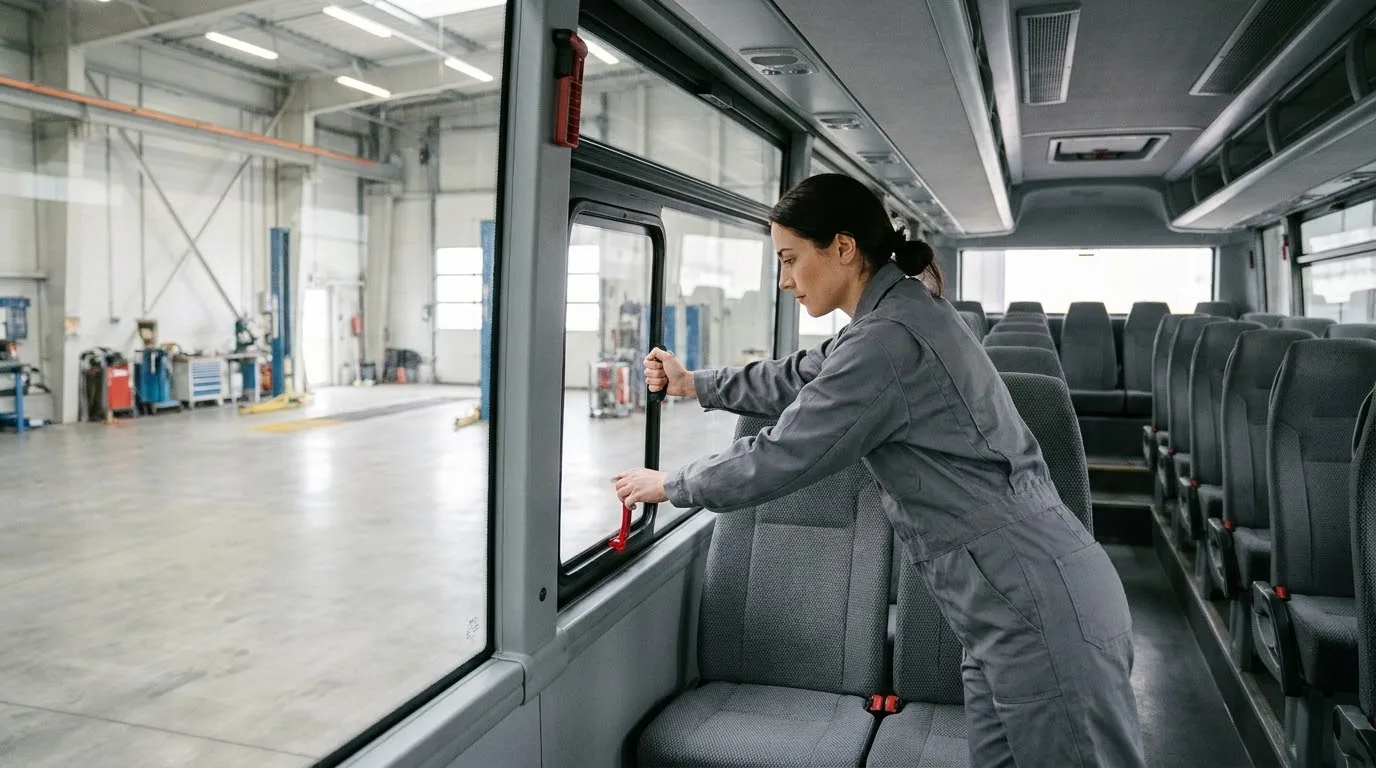
For each vehicle, the file needs four things: identification of the vehicle, a means to show the nature and due date of upcoming inspections and maintenance, a record of the work performed with dates, and, for buses specifically, a record of tests on push-out windows, emergency doors and emergency door marking lights. Those records are kept for one year where the vehicle is housed or maintained, and for six months after the vehicle leaves the carrier’s control. FMCSA guidance confirms that electronic records are acceptable as long as they can be produced on demand.
That fourth item is the one trucking-oriented checklists leave out, and it is a common gap in bus files. If your emergency exit tests live in a technician’s memory rather than in the vehicle record, the program has a hole an auditor will find in minutes. The broader picture of federal requirements for passenger carriers is covered in our guide to DOT compliance for bus and motorcoach operators.
Where coaches differ from trucks
A tractor-trailer carries freight that does not complain. A coach carries 50 or more people who notice everything, and that changes what preventive maintenance has to cover.
Climate control is the obvious example. A failed air conditioning system will not put a bus out of service at a roadside inspection, but on a July charter it will empty the next booking. Passenger doors and their interlocks, wheelchair lifts, restroom systems, onboard power and Wi-Fi all fall in the same category: not always safety-critical, always visible to the customer. A program that treats them as optional ends up servicing them reactively, usually on the worst possible day.

The economics are different as well. When a truck misses a load, the freight waits or moves to another carrier. When a coach fails on the morning of a booked trip, the operator has to find a replacement vehicle, often at short notice and premium cost, or refund a group that will not call again. That is why fleet availability is one of the transportation KPIs bus operators watch most closely.
Measuring whether the program works
Two numbers tell you most of what you need. The first is PM compliance: the share of scheduled services completed on time. A program that consistently runs late exists on paper but not in the shop, and auditors read overdue services the same way. The second is road calls, the breakdowns that require assistance while the vehicle is in service, tracked per vehicle and per 100,000 miles. As preventive maintenance improves, road calls fall, and the pattern of what still fails tells you which tier needs a longer checklist.
Both numbers depend on the same thing: every service, defect and repair recorded against the right vehicle at the moment it happens. If you are deciding how to track that, our buyer’s guide to fleet maintenance software covers what to look for. And if you want maintenance due dates, driver reports and vehicle availability tied directly to trip scheduling, so a coach that is due for service never gets assigned to a charter, see how the QuatroBus transport management platform handles it.